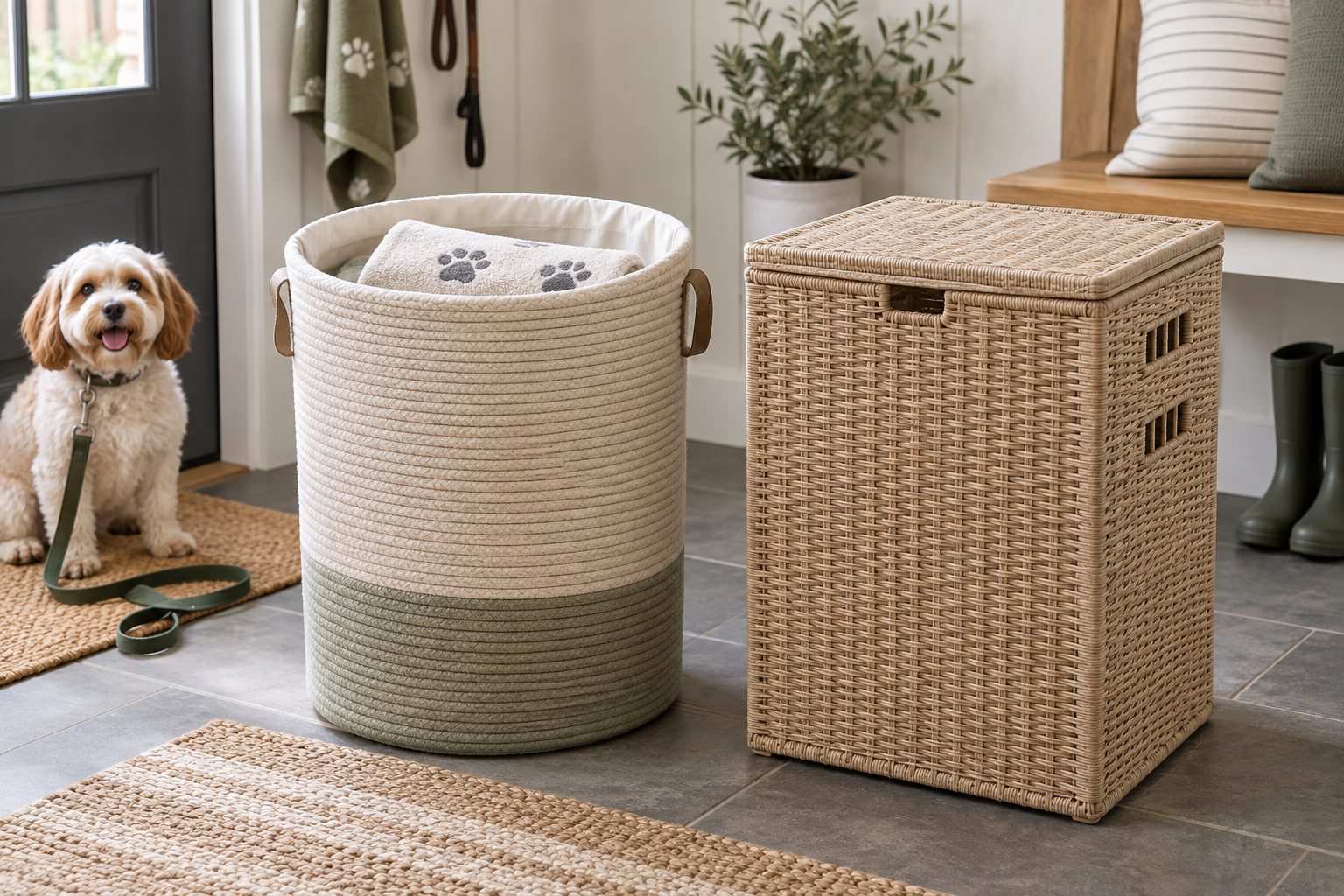
This is temporary laundry storage, not a sanitation or drying solution. A lid does not prevent odor, mildew, or health problems, and ventilation openings do not make it appropriate to store soaked fabric. Follow the towel, liner, and hamper makers' current care instructions. Contact a licensed veterinarian when towels are connected to wounds, discharge, persistent skin irritation, pain, or another health concern.
Quick Comparison
Open hamper: a practical starting point when towels are already aired, you want one-handed loading, and visible contents help you run laundry on time. Lidded hamper: a practical starting point when hiding an already-aired load or limiting casual access matters and the lid can open without hitting a shelf or bench. Choose neither yet: when towels normally go straight to the washer, an existing washable basket works, or there is no suitable airing step.
When an Open Hamper Fits Better
An open top removes a moving part and makes the fill level easy to inspect. It suits a busy entryway when cleanly handled, already-aired towels need a quick handoff and a hinged lid would strike a shelf or require an awkward reach. A removable liner can simplify the route to the washer if its attachment and filled weight are manageable.
The tradeoff is exposure. A curious pet can reach a low open container more easily, and the visible load may look untidy in a shared room. An open top is not the same as effective drying: towels can still bunch together, and airflow depends on the container body, load, and placement. Keep chewable fabric, loops, and drawstrings out of reach where needed.
When a Lidded Hamper Fits Better
A lid can visually contain a dry, used-towel load and place one more barrier between the contents and casual investigation. It may fit a hallway or multipurpose room where visible laundry is the main concern. Look for genuine side or body openings if ventilation is part of the listing, and confirm whether the lid lifts off, flips up, folds, or uses a hinge.
The lid adds steps, clearance, and cleaning points. A flip-up design needs free height and may make one-handed loading awkward; a lift-off lid needs somewhere to go. Hinges, woven edges, recessed pulls, and the underside of the lid can collect debris. Most importantly, a closed top can hide damp towels and delay the reminder to wash them, so the airing and laundry schedule must exist independently of the lid.
What Matters More Than Open or Lidded
- Usable opening: compare the narrowest opening with folded bath towels, paw cloths, and washable mats—not just the exterior width.
- Real load: loosely stack one ordinary between-wash load and measure it. Marketing capacity does not show whether bulky towels pass through the opening.
- Clearance: tape the footprint on the floor and measure lid swing, liner-removal height, door travel, bench overhang, and walking space.
- Ventilation construction: inspect the number, position, and size of openings without treating them as a guarantee about drying or odor.
- Liner design: confirm whether the liner is removable, how it attaches, whether drawstrings remain accessible, and its separate wash and dry directions.
- Carrying: check handle position, frame rigidity, total filled weight, and the complete path to the washer.
- Pet access: consider chewing, pawing, climbing, tipping, and access to soiled fabric. A lid is not a child- or pet-proof lock.
- Materials and edges: inspect woven fibers, frame ends, seams, hinges, coatings, and base contact for damage or roughness.
Setup, Cleaning, and Maintenance
Put the hamper on a level surface outside the door swing and main walking line. Leave the stated operating clearance around its lid and handles. Do not overload the liner or body, and keep the container away from food preparation, pet bowls, clean towels, medicines, cleaners, and grooming tools that require secure storage.
Empty the hamper on a predictable cadence. Clean the body, lid, frame, and liner according to their individual instructions, paying attention to seams, corners, handle joints, ventilation openings, and the lid underside. Let every cleaned part dry as directed before reassembly. Replace or stop using a hamper with unstable supports, sharp cracks, exposed frame pieces, failing handles, damaged hinges, loose hardware, or torn fabric a pet can pull.
Who Should Skip Each Format?
Skip an open hamper when a pet repeatedly pulls at towels or liners, the load must remain out of sight in a shared room, or a deep open basket would be hard for you to empty. Skip a lidded hamper when there is not enough opening clearance, you cannot comfortably operate and clean the lid, or hidden contents would make laundry easier to forget.
Skip buying either when one or two towels go directly to laundry, an existing cleanable basket passes the same size and access checks, or wet towels have no safe place to air before temporary storage. Fix the workflow before adding another container.
Next Steps for the Cleanup Routine
If you want to compare more than lid style, the pet towel hamper guide covers ventilated rigid hampers, framed washable bags, and divided baskets. For the drying step, compare wall-mounted and over-door towel racks. Then connect storage to a doorway cleanup station and compare microfiber and cotton pet towels.
Browse the cleanup and odor-control hub for floor protection, muddy-paw tools, laundry helpers, and other next steps.
Bottom Line
Choose an open pet towel hamper for fast access, visible fill level, and zero lid clearance when the contents can remain safely exposed. Choose a lidded hamper for visual containment when you can operate, inspect, and clean the lid and still keep an independent airing and laundry routine. The better format is the one that fits the measured load, room, pet access, liner care, carrying path, and maintenance you will actually manage.