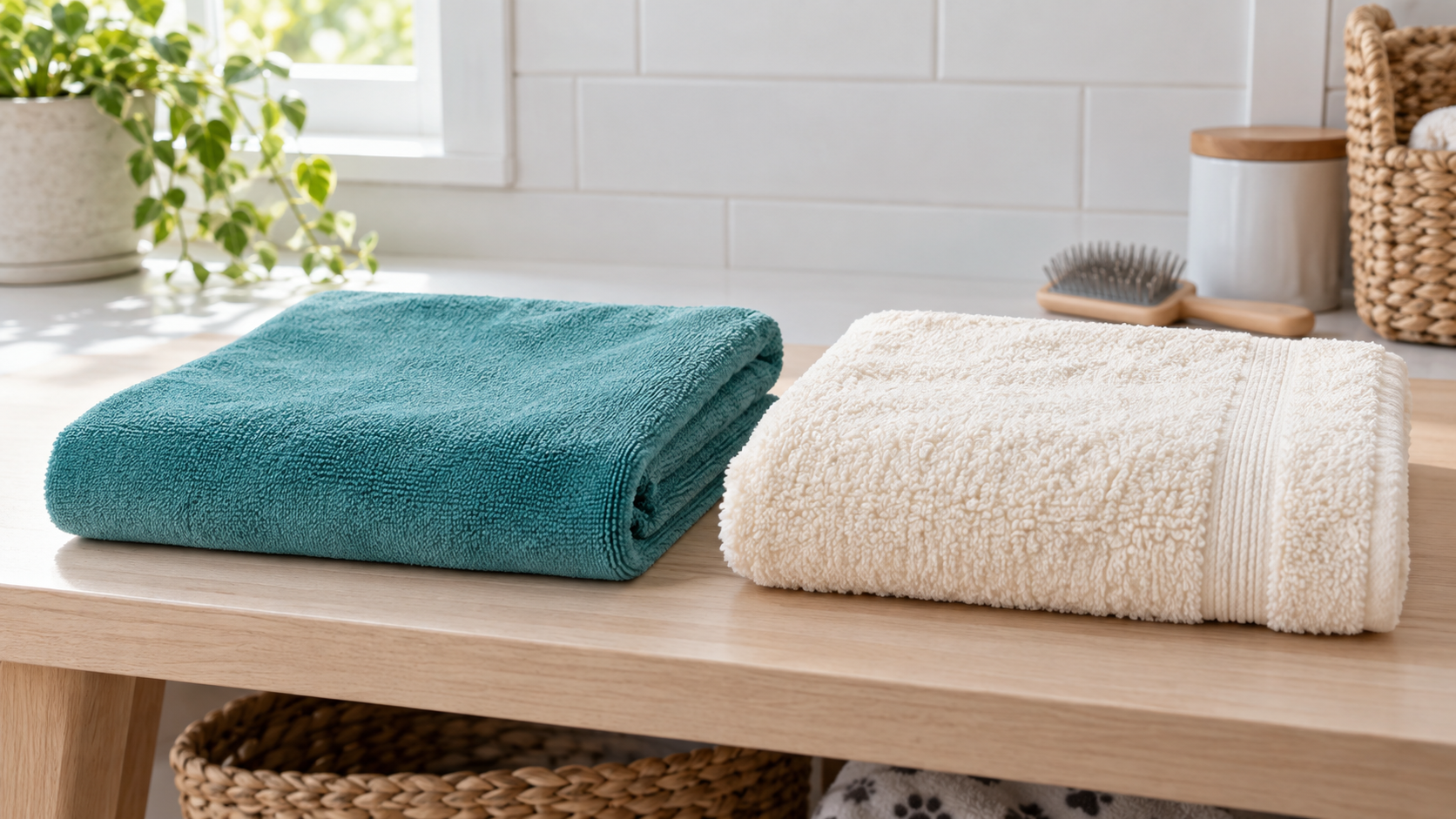
Quick Comparison
Choose microfiber when compact storage, a lighter dry towel, and a fine-pile surface fit your routine—and the specific care label works with your laundry setup.
Choose cotton terry when you prefer a familiar looped towel, already wash similar cotton items, and have room for its wet bulk and drying footprint.
Skip a dedicated pet towel when clean household towels already cover occasional baths or wet paws, or when another towel would create laundry and storage friction without solving a real problem.
Microfiber Pet Towels: Who They Fit
Microfiber towels are commonly made with very fine synthetic fibers and may use smooth, plush, waffle, or chenille constructions. A thinner rectangular version can fold small and is easy to keep near an entryway or in a travel kit. That makes the format useful when storage is tight or several clean towels must rotate through a wet week.
The tradeoff is that “microfiber” covers many constructions. Some surfaces can catch on rough nails, damaged seams, burrs, or hook-and-loop closures. Fine fibers may also hold onto hair or grit until washed. Inspect the weave and binding, shake away loose debris where appropriate, and follow the product's care label rather than assuming every microfiber towel uses the same heat or detergent rules.
Microfiber may fit when
- You need a towel that folds into a small bin, walking bag, or bathroom shelf.
- You want direct control for paws, legs, belly, and small wet areas.
- The pet tolerates the towel's texture and gentle blotting or pressing.
- You can keep the towel away from snag points and retire it when edges or loops loosen.
Skip microfiber when
Skip it if the texture catches repeatedly, the care instructions do not fit your machines, or hair and debris are difficult to remove in your normal wash routine. A familiar clean cotton towel may be the simpler choice.
Cotton Terry Towels: Who They Fit
Cotton terry uses visible loops that give it the familiar structure of many bath towels. It can be easy to add to an existing cotton-towel routine, and owners may already know how much cabinet, hamper, and drying space a towel of a given size needs.
Construction still matters. A dense, oversized cotton towel can become bulky when wet, take up washer space, and be awkward for a small pet or a quick paw wipe. Loose or pulled loops can catch on nails or be mouthed. Check finished dimensions, fabric weight when provided, borders, hanging loops, and washing directions instead of treating cotton as one uniform product.
Cotton may fit when
- You prefer the handling and texture of ordinary terry towels.
- Your laundry routine already accommodates similarly sized cotton items.
- You have enough hanging or dryer space for the towel to dry fully before storage.
- You want a clearly dedicated towel without adding a new fabric-care routine.
Skip cotton terry when
Skip a thick or oversized version when wet bulk is hard to carry, the towel will stay bunched in a hamper, or the available washer and drying space cannot handle it comfortably. A smaller towel or compact microfiber format may be easier.
Compare Size, Grip, and Wet Handling
Start with finished dimensions, not labels such as small, large, or extra absorbent. A paw towel needs less surface area than a whole-body bath towel; a larger or thick-coated pet may need a larger towel or two-towel rotation. For either material, check whether you can keep a secure grip without twisting around the pet or rubbing hard.
Hand pockets can improve grip for some owners, but they fix hand position and add seams that need cleaning and drying. Hanging loops help only when the hook location lets the towel open up rather than remain folded against a wall. Edge binding should lie flat and remain intact.
Laundry, Drying, and Maintenance
- Read the exact label: Fiber blends and construction change care directions. Do not assume universal settings for either material.
- Separate heavy debris first: Remove loose fur, mud, and grit where appropriate before putting the towel into a machine.
- Dry completely: Open the towel fully and follow its drying directions before returning it to a cabinet, bin, or bag.
- Inspect often: Retire a towel with unraveling edges, loose loops, tears, exposed elastic, or pieces a pet can pull free.
- Keep the routine simple: If special washing makes the towel sit damp or dirty, choose a product compatible with the cycle you actually use.
Pet Comfort and Skip Criteria
Use calm handling and blot or press rather than vigorous rubbing around sensitive areas. Stop if the pet stiffens, struggles, mouths the towel, vocalizes, or appears uncomfortable. Do not wrap the face, restrict movement, or leave a pet unattended with a towel that can be chewed or tangled.
A towel is a cleanup tool, not a treatment. Persistent skin redness, sores, unusual odor, hair loss, repeated paw licking, pain, or distress during ordinary handling calls for a licensed veterinarian. A towel purchase should not delay professional care.
Bottom Line
Microfiber is a practical candidate when compact storage and fine-pile handling suit the home. Cotton terry is sensible when a familiar towel construction and established laundry routine matter more. The better choice is the specific towel whose size, edges, wet bulk, care instructions, drying space, and texture fit both the pet and owner—not a universal fiber winner.
For a broader format comparison, continue to the pet bath towel guide for small bathrooms. If wet paws are the recurring problem, organize the whole routine with the pet doorway cleanup station guide.