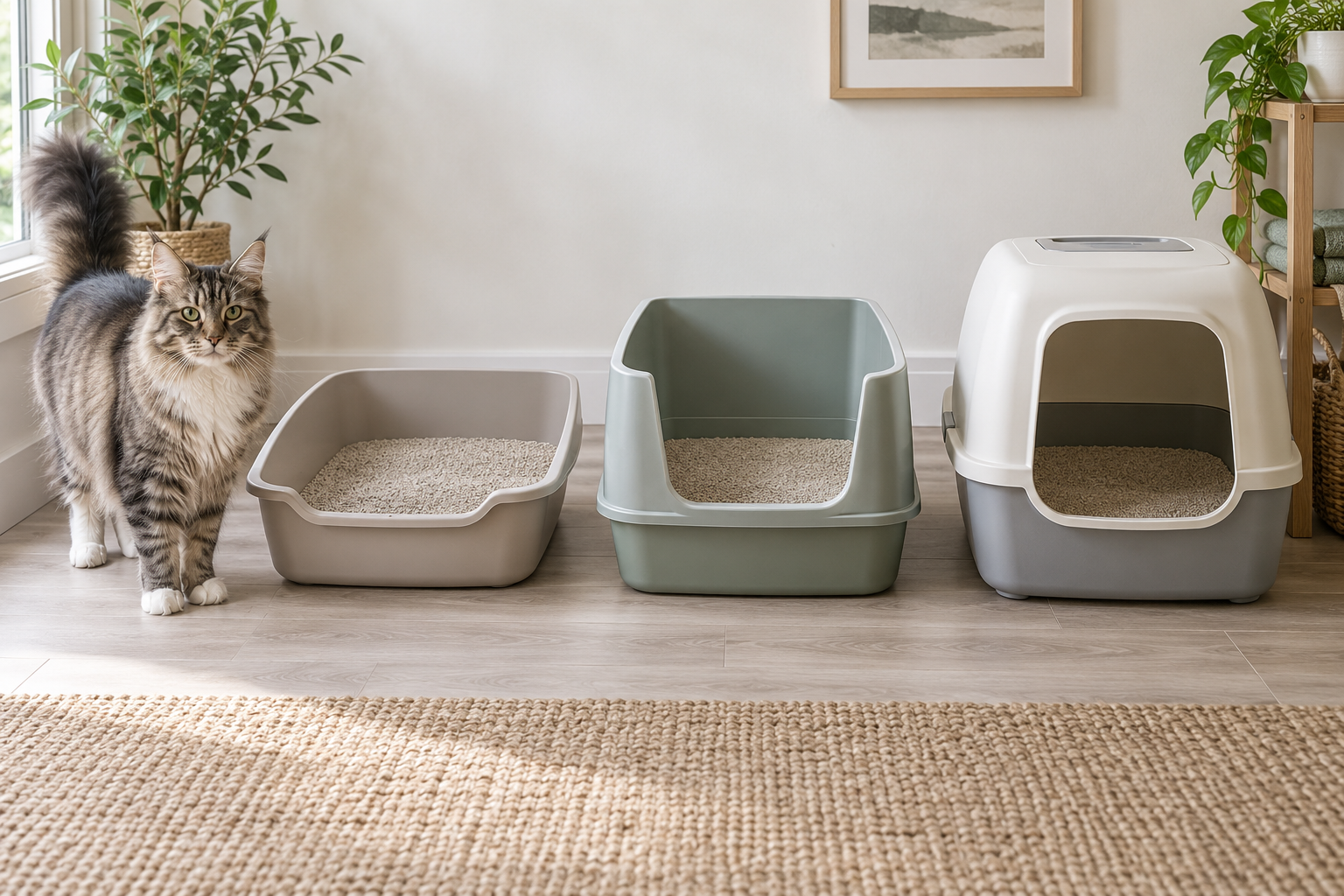
Quick Answer
Start with an open pan when access and easy inspection matter most. Choose a high-sided box with a lowered doorway when measured fit works and more wall coverage helps. Consider an enclosed box only when its doorway, headroom, and turning space fit—and your cat already accepts a covered setup.
A larger box can improve room to move, but it cannot diagnose or fix a sudden change in litter-box use. Straining, pain, blood, repeated trips, or inability to pass urine need prompt veterinary attention; difficulty passing urine can be an emergency.
Measure the Cat, Box, and Route
Observe the space your cat uses to stand and turn comfortably, then compare that need with the box’s flat interior floor—not only its longest exterior dimension. Sloped walls, corners, rims, liners, and covers reduce usable space. Measure entrance width and height separately.
Mark the full assembled footprint on the floor. Leave space to approach, scoop, and remove a lid or rim. Confirm the empty box fits through doors and into the wash area. If a listing omits interior or doorway dimensions, ask the seller or skip it rather than guessing from “large cat” wording.
How the Formats Differ
Roomy open pans
Open pans make the interior visible and offer several approach angles. One-piece versions can simplify washing. Lower walls offer less coverage, and a flared shell may have less flat floor than its exterior suggests.
High-sided boxes with lowered doorways
Higher side and back walls add coverage while a lowered front creates an entry. Measure the opening and flat floor behind it. Skip a narrow doorway, unstable rim, rough edge, or shell too awkward to wash.
Enclosed boxes with broad entrances
A cover changes entry, headroom, airflow, sightlines, and cleaning. It does not guarantee containment or odor control. Check that the cat can stand and turn without pressing into the roof and that the cover removes cleanly. Never force a cat into a covered box.
A Practical Buying Checklist
- Usable floor: Check interior length and width after slopes and corners.
- Entry: Verify width and height for the individual cat; do not infer fit from breed labels.
- Headroom and walls: Check standing clearance, flare, rims, and cover shape.
- Stability: The box should sit flat during entry and digging.
- Cleaning: Inspect seams, joints, corners, lid hardware, and surface access.
- Handling: Plan how to lift, empty, wash, dry, and return it.
- Room fit: Include approach, scooping, lid-removal, and door clearance.
- Return terms: Confirm them before adding litter.
Follow current maker care directions. Stop using a cracked, sharp-edged, unstable, or uncleanable box. For the floor, compare cat litter mat formats.
Who Should Skip Each Format?
Skip an open pan if its walls do not suit the actual digging pattern. Skip a high-sided box if entry is awkward or cleaning is cumbersome. Skip an enclosed box if your cat avoids covers, the interior is cramped, or the room lacks lid-removal space.
Skip buying another box when the current one already provides comfortable space, access, stability, and manageable cleaning. If litter-box behavior changes suddenly or persists, contact a veterinarian instead of cycling through products.
Bottom Line
For a large cat, measured usable space beats an “XL” label. Measure comfortable movement, box interior and doorway, installed room, and wash route before choosing.