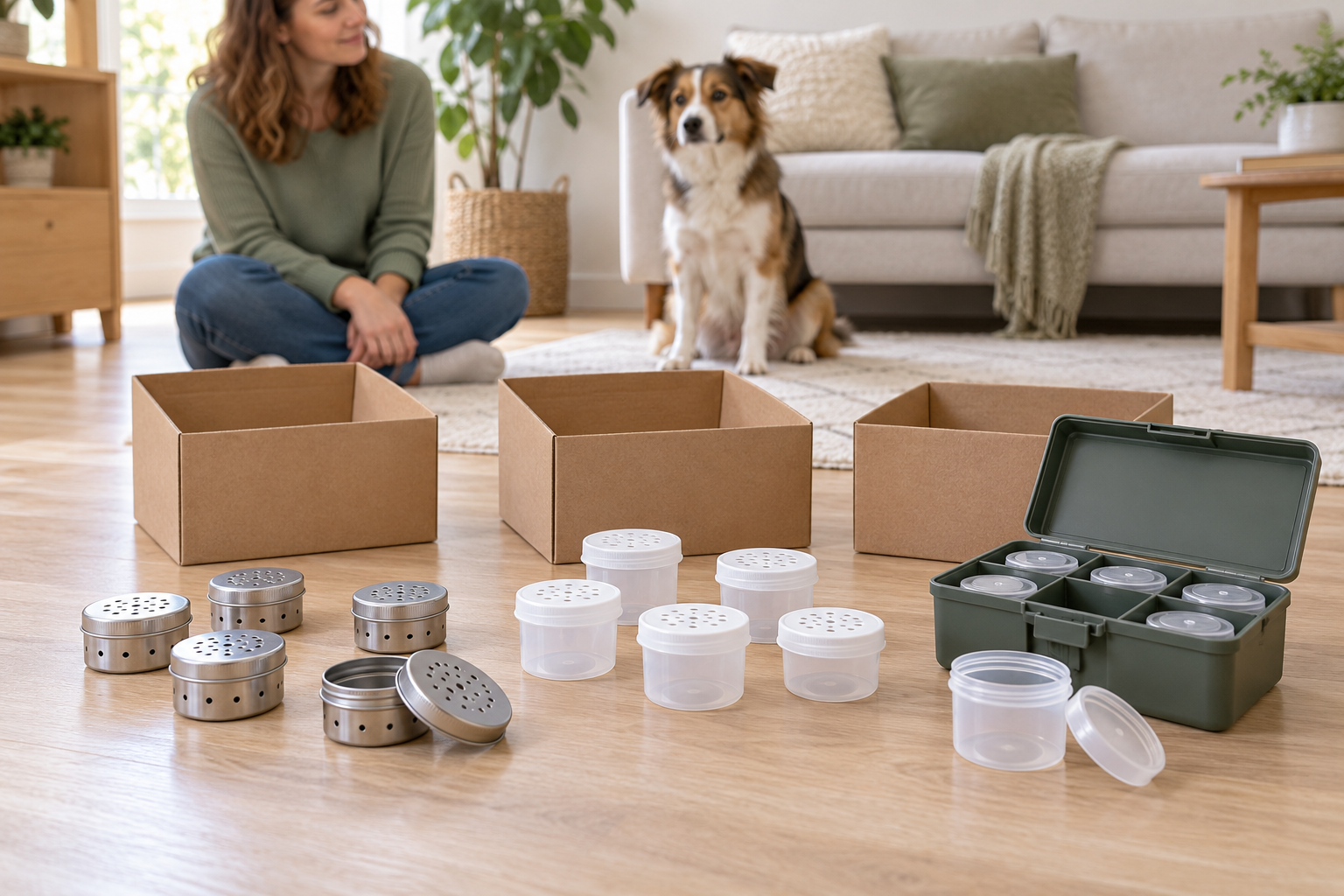
Quick Answer
Choose perforated hide tins when you want a compact reusable format and the exact set has smooth openings, secure lids, clear attachment directions, and a reliable inventory routine.
Choose larger vented vessels when easy visibility and handling matter more than compact hiding. Their dimensions still need to fit the maker’s intended setup and stay inaccessible to the dog’s mouth.
Choose an organized storage kit when keeping every component counted and closed away is the main practical problem. More pieces are useful only if each has a defined purpose and replacement route.
This equipment supports a short, voluntary, owner-led activity. It does not treat anxiety, improve behavior on demand, guarantee mental or physical fatigue, or prepare a dog for professional detection work. For formal scent-work training, difficult arousal, guarding, or other behavior concerns, ask a qualified reward-based trainer.
Audit the Routine Before Buying
Start with the simplest question: do you need a kit? A few clean, dog-inaccessible household containers may be enough for casual hide-and-find games when a qualified instructor’s or reputable program’s directions allow them. A purchased kit earns its place when standardized containers, a complete inventory, replacement parts, and beginner instructions make the routine easier to repeat.
Read the current instructions before choosing a scent source. Do not substitute essential oils, household chemicals, medications, powders, or unfamiliar substances. The page cannot determine what is appropriate for an individual dog or training program. If the exact kit does not clearly explain intended materials, handling, storage, and disposal, skip it.
Measure the room as well as the pieces. Use a calm indoor area with a dry, nonslip floor, clear walking paths, and no breakables, cords, unstable furniture, food, medications, or household chemicals within reach. Start with an easy layout rather than hiding tiny items throughout the home.
How the Three Formats Differ
Perforated metal hide tins
These compact containers commonly use openings in the lid or body. Compare the finish around every opening, lid security, attachment method, and whether the full container can be recovered easily. Small metal pieces can become ingestion or chewing hazards; they should never be placed loose where the dog can mouth them.
Vented plastic vessels
Larger translucent or opaque vessels can be easier for the owner to see and count. Compare wall thickness, closure, vent design, and cleaning instructions. Plastic is not automatically chew-safe, and a larger container is not permission to leave it with the dog.
Container sets with storage cases
A compartmented case can make inventory simpler, especially when the set includes several vessel types. Check that every cavity fits its intended part, the case closes securely, and the instructions identify the contents. A case is storage for the owner, not a search object or dog-accessible toy.
Buying Criteria That Matter
- Complete contents list: Know the number and purpose of every vessel, lid, holder, attachment, and accessory.
- Finished openings and edges: Skip burrs, sharp edges, cracks, or rough unfinished holes.
- Secure closures: Lids should work as the maker describes without loose or improvised parts.
- Clear scent-source directions: Follow only the exact kit’s current documentation or qualified instructor guidance.
- Recoverable dimensions: The owner must be able to see, count, and retrieve every component after the game.
- Cleaning separation: Check which parts can be washed, how they should dry, and whether scent-dedicated storage is specified.
- Replacement route: Confirm compatible containers or consumable pieces are identifiable without mixing systems.
- Closed storage: The complete kit should fit a dry, labeled place inaccessible to pets and children.
- Beginner documentation: Prefer plain setup, handling, inventory, and stop directions over vague performance claims.
Ignore claims that a kit is professional, competition-ready, calming, or universally safe unless the exact meaning is documented and relevant. For a beginner home activity, understandable directions and reliable inventory matter more than an oversized accessory bundle.
A Controlled, Supervised Setup
Count the components before and after every session. Place a vessel only as the maker directs and keep it physically inaccessible to the dog’s mouth; an open cardboard box or other approved outer search container can create separation without making the small vessel a toy. Keep the dog out of the setup area while arranging hides so nothing is grabbed early.
Let participation remain voluntary. Do not push the dog toward a container, force contact, or treat confusion as disobedience. Stop if the dog mouths, paws hard at, guards, damages, or tries to swallow any component; if the owner loses track of a piece; or if the dog shows distress. Suspected ingestion, exposure to an inappropriate substance, sudden illness, or injury needs prompt veterinary guidance.
Afterward, recover and count every item, clean only as directed, let appropriate washable pieces dry fully, and close the complete kit in secure storage. Do not mix kit pieces with ordinary dog toys or leave prepared scent materials in shared household storage.
Who Should Skip a Starter Kit?
Skip it if instructions are incomplete. An unclear scent source, missing contents list, vague cleaning guidance, or unexplained small accessories is a reason to choose a better-documented system.
Skip it if the dog routinely mouths or swallows objects. A trainer can suggest a different activity setup, and a veterinarian should address suspected ingestion or medical concerns.
Skip it if the household cannot control access. Small vessels and prepared materials require complete inventory and secure, separate storage.
Skip buying a kit if a familiar supervised toy, a simple scatter-free sniffing routine, or instructor-approved household containers already provide an easy activity. This is convenience equipment, not a requirement for worthwhile enrichment.
Related Enrichment Guides
Use the supervised enrichment framework to compare size, materials, cleaning, difficulty, and temperament across product types. For food-based options, compare beginner dog snuffle mats or beginner dog puzzle toys. For faster interactive play, first decide whether a flirt pole fits the dog, handler, and space.
Bottom Line
The best starter kit is the simplest one you can document, inspect, count, clean, and lock away. Pick hide tins, larger vented vessels, or an organized case around the owner’s handling routine—not promises about behavior, fatigue, or expertise—and follow current maker or qualified-instructor directions for the exact scent source and setup.