Quick Answer
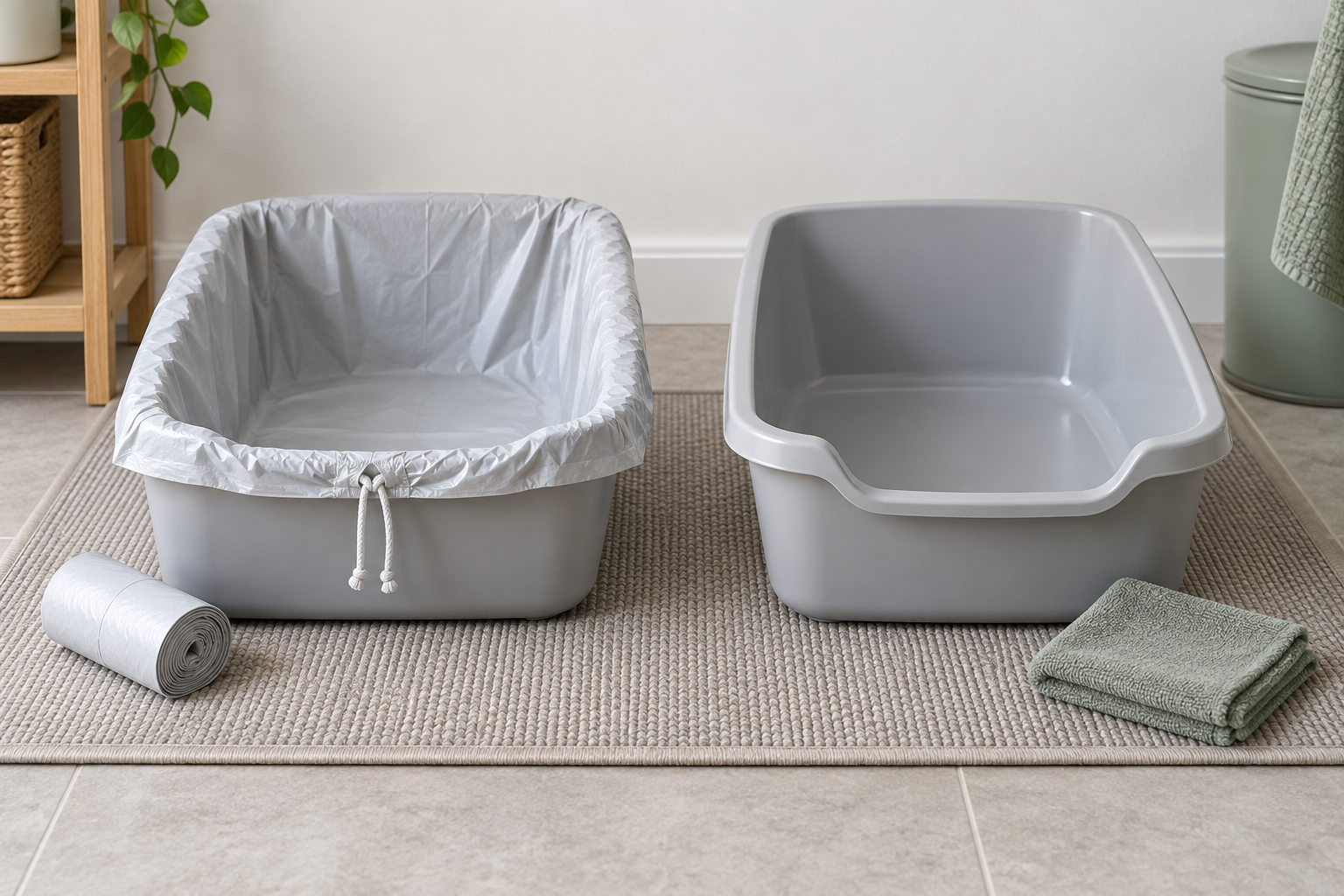
Choose a liner when the exact box allows it, the liner covers the interior without pulling tight or pooling loose material, the edge stays out of your cat's way, and you can lift it without spills or tears. This format fits owners who value a contained full-change step and accept ongoing purchases and disposal.
Choose a bare box when you want maximum usable interior space, fewer loose edges, no liner compatibility problem, and no recurring liner supply. It fits owners who can empty, wash, rinse, and fully dry the complete box according to its maker's directions.
Choose neither setup automatically. Observe what your cat already accepts. A maintenance shortcut is not useful if it changes footing, catches claws, bunches into the litter, or makes the usable box smaller.
Measure and Check Before Adding a Liner
- Maker guidance: confirm that the exact litter box permits liners. Automatic boxes, removable-rim designs, unusual shapes, and some sifting systems may have specific restrictions.
- Interior dimensions: measure length, width, wall height, corners, entry cutout, and any internal ledge. Product size labels are not a substitute for these measurements.
- Rim attachment: compare drawstring, elastic, fitted-corner, or fold-over designs by how they sit on the actual rim without blocking entry or interfering with a lid.
- Loose material: a liner should not create deep folds, floating edges, or a tight suspended surface. Check the setup empty, then again with the usual litter depth.
- Usable area: make sure the lined setup still leaves the normal interior space and entry clear. Do not force an undersized liner over the box.
Practical Tradeoffs
- Full changes: a sound liner may let you gather and lift litter as one unit. A bare box requires pouring or scooping out the remaining litter before washing.
- Punctures and bunching: liner material can tear, wrinkle, or shift during normal digging. A bare box has no removable layer but can collect scratches and residue according to its material and age.
- Recurring supplies: liners need storage, restocking, and disposal. A bare setup avoids that purchase but still needs appropriate cleaning tools and drying space.
- Box access: liner edges can conflict with low entries, removable rims, lids, or internal features. The bare box preserves the shape the maker designed.
- Visual checks: a light-colored liner can make tears visible, while folds can hide litter or mess. A smooth bare interior is easier to inspect but may show wear differently.
- Cat acceptance: some cats ignore a fitted liner; others may notice its feel, sound, movement, or loose edges. Do not assume either response in advance.
A liner does not make a litter box sanitary, odor-free, leakproof, or acceptable to every cat. It is a convenience layer, not a health or behavior solution.
Plan the Full-Change Routine
For a lined box, inspect for holes and exposed edges before each refill. During a full change, gather the closure slowly while the box remains supported, follow local disposal rules, and stop if the liner begins to split. Clean and dry the underlying box whenever material or liquid reaches it, and periodically inspect the empty box even when the liner looks intact.
For a bare box, remove all litter without scraping more aggressively than the maker permits. Follow the box maker's cleaning directions, rinse as directed, and let the box dry fully before refilling. Replace a box when its maker advises or when cracks, damaged seams, sharp areas, or surfaces you can no longer maintain make continued use unsuitable.
Keep either routine consistent enough that you can notice a meaningful change in use. Sudden avoidance, straining, vocalizing, repeated trips, or elimination outside the box needs prompt veterinary guidance; changing liners is not a diagnostic test or treatment.
Who Should Skip Each Setup?
Skip a liner when the box maker prohibits it, no measured option fits without folds or tension, your cat pulls or chews it, claws repeatedly catch it, the rim cannot close correctly, or lifting a full liner is awkward. Skip it as well when recurring plastic use or restocking defeats the convenience you wanted.
Skip a bare setup when you cannot safely empty, lift, clean, rinse, and dry the whole box on the needed schedule. That is a reason to reconsider box size, weight, placement, or help with the routine—not a reason to use a poorly fitted liner.
Pause either change if your cat is already avoiding the box or showing a new elimination pattern. Preserve access to an accepted setup and contact a veterinarian rather than introducing several changes at once.
Next Steps for the Litter Area
If the box itself is the unresolved decision, compare covered and open litter boxes by usable space, access, cleaning, and room fit. For daily removal tools, use the stainless steel versus plastic litter scoop comparison. If tracked granules are the separate problem, decide whether a litter mat earns its floor space.
Bottom Line
A well-fitted, box-approved liner can make the full-change lift more contained, but it adds loose material, fit checks, recurring purchases, and disposal. A bare box is simpler in parts and preserves the designed interior, but the box itself carries the full washing and drying job. Choose the setup your cat accepts and that you can maintain reliably—without expecting either one to solve odor, health, or litter-box behavior.