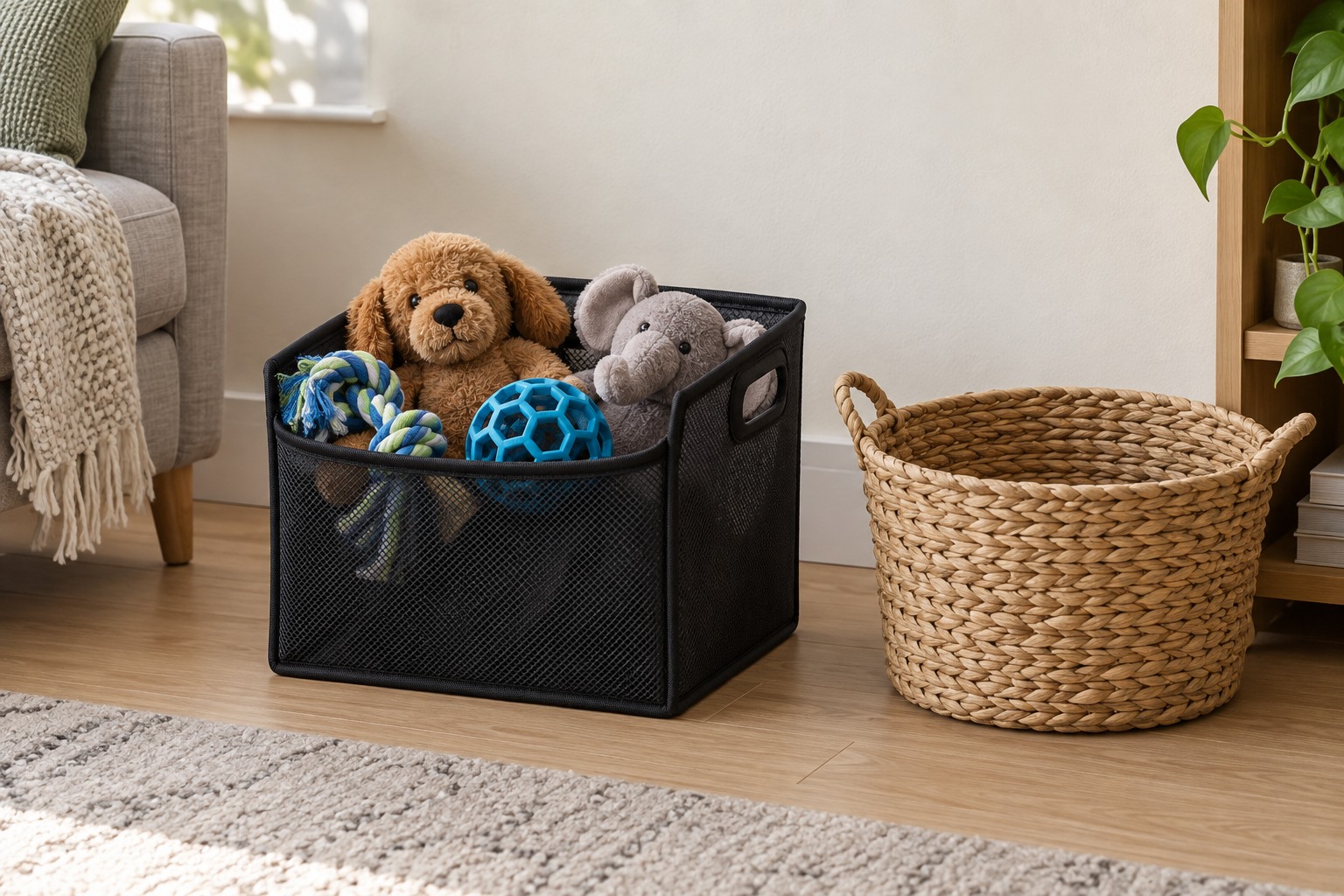
This is a category decision, not a promise that storage will change chewing, guarding, boredom, or play behavior. The bin is for organizing inspected toys within an owner-managed routine.
Quick Answer: Buy, Reuse, Choose Closed Storage, or Skip?
Buy mesh when quick visual checks solve a repeated rotation problem and every toy is larger than the openings. Reuse an existing basket when it already fits the toys, cleans acceptably, and stays stable. Choose closed storage for supervised-only toys or when your pet should not reach the container. Skip a floor bin when the bin itself attracts chewing, climbing, or guarding.
The Six-Part Worth-It Test
- Visibility: Do toys currently get missed because opaque walls hide them?
- Retention: Is the smallest stored toy or part larger than every mesh opening?
- Snag check: Can rope strands, wand cords, tags, plush loops, or damaged edges catch in the mesh or binding?
- Structure: Does the stated open size fit the floor space without collapsing into a walkway?
- Reset: Can you empty, clean, fully dry, and inspect the sides, frame, handles, seams, and base?
- Pet access: Can every reachable toy be left out appropriately, and does your pet ignore rather than chew or climb into the bin?
When Mesh Is Worth the Cost
Mesh is useful when a varied rotation includes several toys that are easy to overlook. Seeing through the walls can shorten a quick inventory and help an owner notice which clean, intact items are available. A lightweight format may also be easy to move during the room reset.
That benefit matters only if the bin keeps a useful shape and the openings suit the actual contents. Measure the widest floor dimension, usable interior height, shelf or furniture clearance, and the smallest toy. Treat “large” or “small” labels as marketing until the listed dimensions work in your room.
When an Existing Basket Is Enough
Keep the basket or household bin you already own when it holds the current rotation, stays out of the walkway, and can be cleaned by a method you will follow. You can improve visibility without buying anything by keeping fewer toys in the active basket and storing inspected backup toys in an inaccessible owner-managed location.
If the real issue is too many toys rather than opaque sides, start with the simple pet toy rotation guide. A new container will not fix an overfilled or rarely inspected rotation.
Cost, Setup, and Maintenance Tradeoffs
The purchase price is only one cost. Check whether the bin arrives structured or requires frame assembly, whether it folds, and whether the base is removable. A collapsible bin can store compactly but may need more frequent reshaping; a rigid frame uses permanent space and must be inspected for exposed edges if fabric or mesh is damaged.
Follow the maker's cleaning directions rather than assuming mesh is machine washable. Empty crumbs and debris, clean the approved surfaces, and dry every layer completely before returning dry toys. Mesh openings do not make damp storage sanitary, and a wet toy should not be left in the bin to “air out.”
Red Flags Before You Buy
- No clear open dimensions or only vague capacity language.
- No useful view of the mesh openings, seams, base, or internal frame.
- Openings large enough for small balls, toy parts, tags, cords, or rope ends to protrude.
- Unclear care directions for mixed mesh, fabric binding, board, or metal components.
- Handles, loops, or loose trim your pet is likely to mouth.
- Claims that ventilation alone keeps damp toys fresh or clean.
Who Should Skip a Mesh Toy Bin?
Skip mesh when your pet chews fabric, pulls at seams, climbs into containers, or swallows non-food items. Use inaccessible closed storage and bring out suitable toys intentionally. Also skip open storage if toys trigger guarding or conflict between pets; a qualified trainer or behavior professional can help plan safer routines.
Stop using any bin with torn mesh, exposed frame pieces, loose binding, or an unstable base. Retire damaged toys during each reset. Contact a veterinarian if a pet may have swallowed mesh, fabric, toy filling, rope, or another non-food item, or shows sudden illness or pain.
Choose an Alternative
A solid-sided washable bin contains more loose debris and visual clutter. A low repurposed basket costs nothing when it is already suitable. A lidded container or cabinet supports an owner-managed rotation when toys should stay inaccessible. Compare the construction tradeoffs in the mesh versus solid-sided toy bin guide, or use the broader small-living-room toy storage guide when footprint is the main constraint.
Bottom Line
A mesh pet toy bin is worth it when visibility improves a real inspection and rotation routine, the openings retain every item, the construction is easy to inspect, and open floor storage suits your pet. Reuse what you have when it already works. Choose closed storage—or skip a container purchase—when access, chewing, snagging, or clutter is the larger problem.