 Nesting sets with a case
Both formats are convenience gear, not hydration or health solutions. Pack enough fresh water for the pet, conditions, and length of the outing. Follow current manufacturer directions, and contact a licensed veterinarian if your pet refuses water, drinks much more or less than usual, vomits, appears overheated, or seems unwell.
Quick comparison
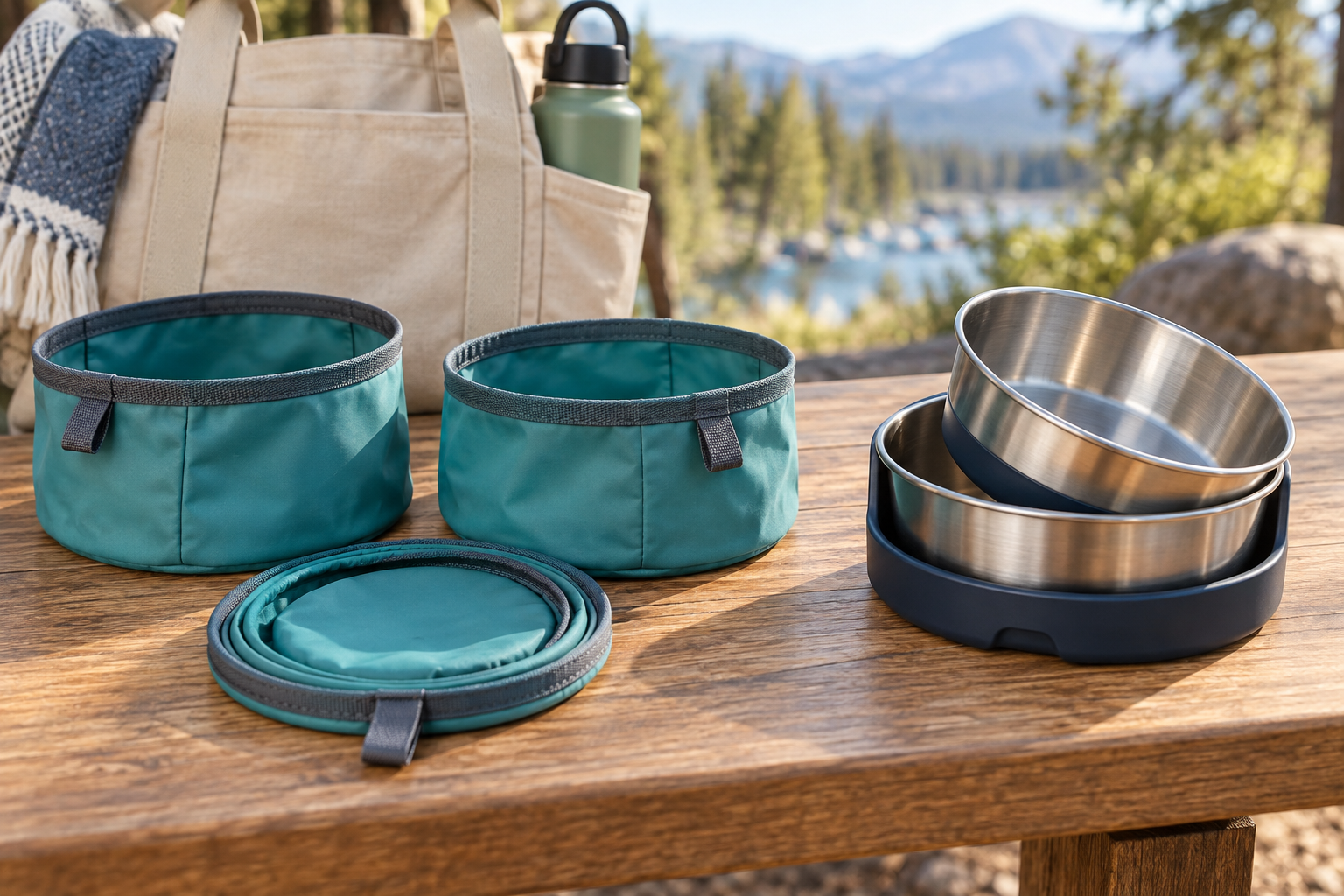
- Packed shape: folding bowls make a broad, shallow stack; nesting bowls create a narrower but deeper bundle.
- Setup: folding bowls need to be opened and shaped; rigid nesting bowls separate and are ready to place.
- Stability: a rigid bowl generally keeps its rim and base shape, while a light folding bowl may shift or flex when nudged.
- Cleaning: folding bowls require attention around seams, hinges, and edge binding; nesting bowls need every contact surface separated, washed, and dried.
- Kit organization: folding pairs can slide beside flat gear, while nesting sets keep multiple bowls together as one defined stack.
Who flat-folding bowls fit
Choose flat-folding bowls when the outing bag has more width than depth. A pair can sit against the back of a tote, in a seat-back organizer, or beside documents without creating the rounded bulge of stacked rigid bowls. They also make sense when food and water need separate bowls but your kit must remain thin.
The tradeoff is structure. Compare the usable dimensions after the bowl is fully opened, not just its folded diameter. Check whether the rim holds its shape, whether the base sits flat, and whether seams or hinges can be reached during washing. A thin packed profile is not useful if the open bowl is too shallow or easily collapses during ordinary use.
Who nesting bowls fit
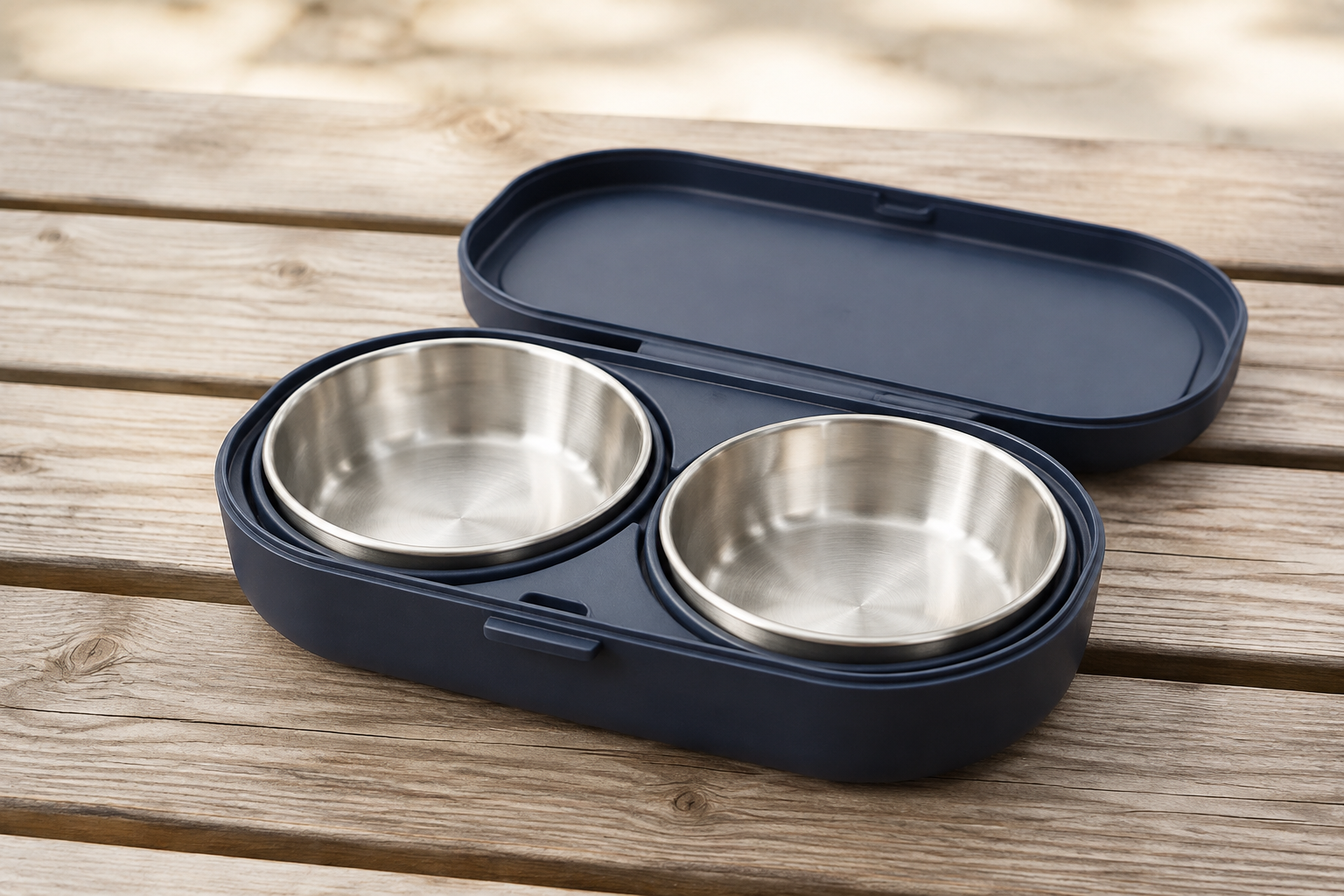
Choose nesting bowls when your tote, vehicle bin, or food container has enough vertical clearance for a rigid stack. Separate bowls can give food and water a defined surface, and smooth rigid interiors may be simpler to inspect for residue than layered fabric. A fitted case or carrier can keep the set together.
The compromise is packed depth and trapped moisture. Measure the complete nested set, including its lid, case, handle, or base—not only one bowl. Bowls that fit tightly may be awkward to separate with wet hands, and moisture can remain between nested pieces. Never restack them for storage until every surface is clean and fully dry.
Measure the whole multi-bowl kit
Start with the number of bowls you genuinely need. A two-bowl set may handle separate food and water for one pet, but shared bowls are not appropriate for every routine or group. Compare each bowl's stated capacity and open dimensions with your pet's ordinary bowl; “travel size” does not describe usable volume.
Then measure the packed set. For folding bowls, record the widest folded dimension and the thickness of both bowls together. For nesting bowls, record the stack's widest point and total height with any carrier closed. Test those numbers against the actual compartment while leaving room for a water bottle, food container, towel, and waste supplies.
Setup and surface tradeoffs
Open and close the folding set at home until the sides sit as intended without force. Inspect flexible hinges, creases, edge binding, fasteners, and loops. For a nesting set, check that bowls separate without sharp movement, sit level without the carrier, and do not expose rough edges or loose small parts.
Use either format on the flattest clean surface available. A broad base can help, but no portable bowl is universally spill-proof or tip-proof. Add a modest amount at a time, keep the bowl where it cannot become a trip hazard, and supervise access. Do not let pets chew fabric, rims, carriers, clips, or cases.
Cleaning, drying, and maintenance
Empty each bowl after use and wash it according to its current care label. With folding bowls, open every crease and clean seams, corners, hinge areas, and edge binding. With nesting bowls, remove every piece from its carrier and wash all surfaces that touched food, water, another bowl, or the ground.
Dry every component separately before folding, nesting, closing, or packing it. Inspect for cracks, sticky surfaces, frayed seams, exposed wire, loose trim, rust, sharp edges, or a closure that no longer works predictably. Replace damaged pieces rather than improvising repairs where a pet could reach adhesive, thread, or small hardware.
Who should skip each format?
Skip flat-folding bowls if your pet pushes flexible sides inward, the folds cannot be cleaned easily, the open capacity is too small, or your bag has no flat protected compartment. Skip nesting bowls if the stack consumes needed bottle space, the pieces jam together, or the carrier makes complete washing and drying difficult.
Skip both if a familiar lightweight rigid bowl already fits your vehicle or day bag, if your pet chews portable gear, or if you cannot wash and dry the set promptly after use. If one compact bowl is enough, the broader collapsible-bowl guide offers simpler varieties. If wet storage is the main problem, compare storage sleeves for dry collapsible bowls—but do not seal a wet bowl in a sleeve.
The bottom line
A flat-folding set fits a shallow compartment and an owner willing to open, wash, and dry its flexible construction. A nesting set fits a deeper bag and an owner who values rigid sides and a defined multi-bowl stack. Choose only after comparing open capacity, complete packed dimensions, surface stability, cleaning access, and the space left for the rest of the outing kit.