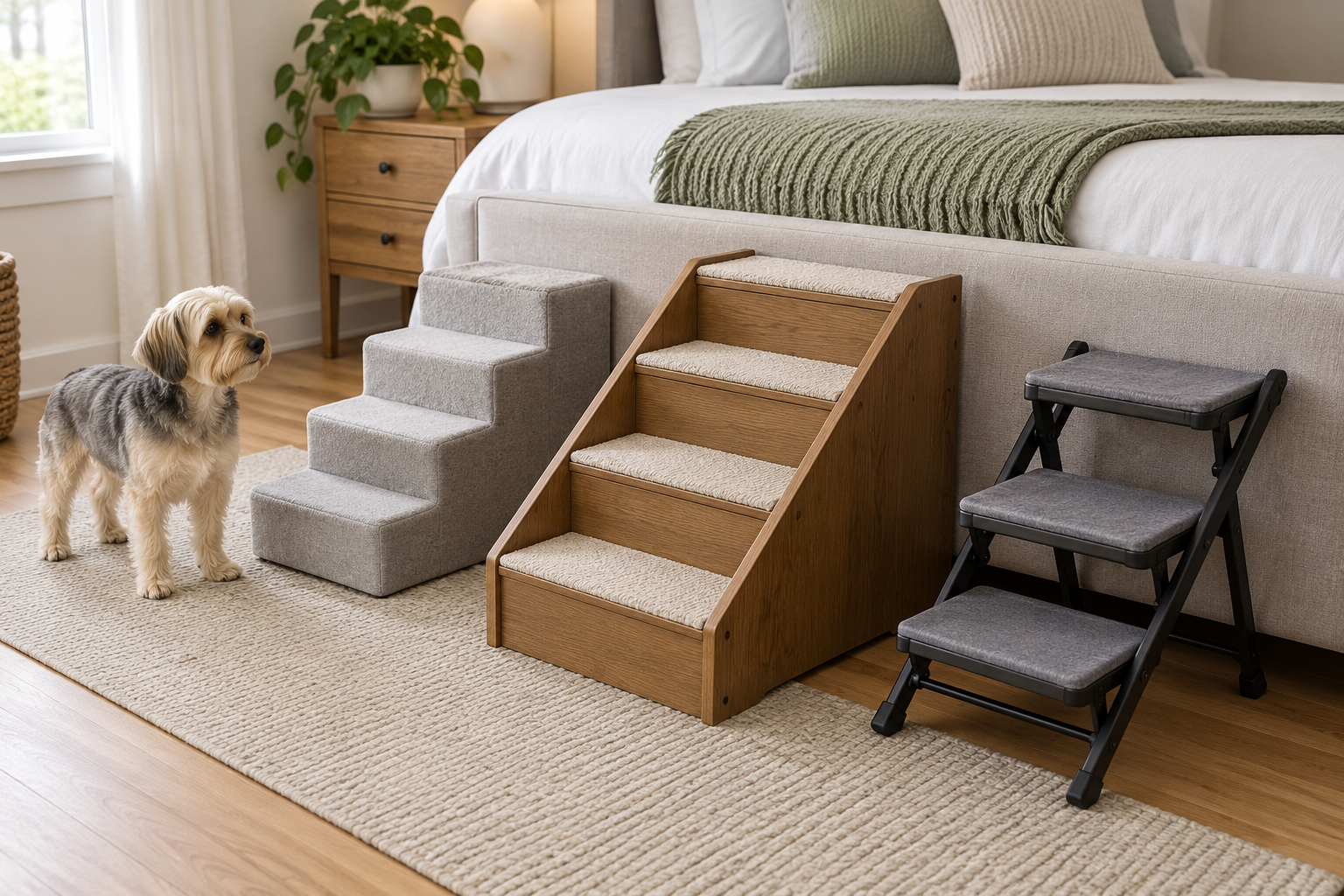
Quick Answer
Compare narrow foam stairs when side-to-side width is the firm constraint and the verified treads remain usable. Compare deep-tread rigid stairs when a larger landing surface and a less compressible structure justify more floor depth. Compare foldable stairs when the product must move out of a walkway and you can verify the open lock, floor contact, and handling routine.
A high bed does not automatically call for the tallest stair set. The top step needs to meet the maker-approved landing position without leaving an awkward final gap, while every intermediate rise and tread must suit the intended pet under current maker guidance. If mobility has changed suddenly or pain may be involved, ask a veterinarian before treating stairs as the answer.
Measure the Bed and Small Bedroom Before Shopping
Measure from the floor to the exact surface the pet would step onto, not just the bed frame. Record the available width along the bed and the maximum distance the stairs can project into the room. Then open drawers and doors, walk the nighttime route, and account for baseboards, rugs, cords, vents, and the space needed to make the bed.
Compare those numbers with complete assembled dimensions. Product names such as “high,” “large,” or “space-saving” are not measurements. Also note the top-step position relative to the mattress edge; do not improvise blocks, risers, ties, wall fasteners, or other height changes unless the maker expressly permits them.
How the Three Stair Formats Differ
Narrow foam stairs
Foam stairs can reduce side-to-side width and are often simpler to lift for cleaning. The tradeoff is that foam firmness and compression vary, a narrow format can also mean a smaller usable tread, and a removable cover may shift or change fit after washing. Check the exact uncovered structure, cover attachment, zipper location, base treatment, laundering directions, and drying requirements.
Deep-tread rigid stairs
A rigid frame can provide a defined tread shape and may offer more landing depth, but it usually projects farther into the room and can be heavier to reposition. Review joints, fasteners, side panels, tread attachment, exposed edges, floor-contact parts, cleaning access, and whether assembly or periodic tightening is required.
Foldable stairs
Folding stairs can clear a closet or walking path between uses. They introduce hinges, locks, moving joints, and a setup step that deserves careful checking each time. Confirm the fully open footprint, folded size, product weight, carry points, lock directions, tread material, and whether the maker permits repeated relocation.
Buying Criteria That Matter
- Total rise: match the exact current product height to the intended bed landing using maker directions.
- Individual step rise: count the vertical change between every tread rather than relying on the number of steps.
- Usable tread: compare the flat depth and width available after side rails, rounded edges, cover seams, and frame parts.
- Complete footprint: include feet, braces, hinges, projections, and the space needed to approach and leave the stairs.
- Stated load and intended use: follow current maker limits and pet-size guidance; do not infer suitability from appearance.
- Floor contact: verify permitted floor types and the included base treatment. An added mat is not automatically an approved fix.
- Materials and chewing: inspect foam, fabric, wood, plastic, fasteners, and exposed edges; stop access if the pet mouths or damages parts.
- Cleaning: check cover removal, wash method, drying, surface wiping, seams, and access beneath each tread.
- Storage: measure the actual closet, under-bed, or beside-bed space and confirm the folded or carried dimensions.
- Returns: understand assembly and return conditions before removing packaging or allowing pet use.
Placement, Introduction, and Upkeep
Assemble or open the stairs exactly as directed in the measured location. Check every maker-identified fastener, lock, cover, tread, foot, and floor contact before access. The top landing should align as instructed and the stairs should not block an exit, create a blind trip point, or sit where bedding can catch on them.
Let the pet investigate without pulling, placing, or rushing them onto the stairs. Supervise the first uses and stop if the product shifts, compresses unexpectedly, changes shape, develops a loose cover or joint, or the pet jumps from the side. Follow the maker’s inspection schedule, and allow washed covers and surfaces to dry completely before reassembly.
Small rooms amplify clutter. Keep shoes, cords, storage baskets, and bedding away from the approach and landing. If stairs must be moved daily, choose a location for the folded product before buying and repeat the full setup check whenever it returns to use.
Who Should Skip Pet Stairs for This Setup?
Skip this narrow buying decision if you have not yet chosen between stairs and a ramp. The broader pet steps and ramps guide covers the format tradeoff first.
Skip stairs when the measured footprint blocks normal movement. A lower pet sleeping surface or a different furniture arrangement may be more practical than a product that lives in a doorway or nighttime path.
Skip any set that depends on an improvised height, brace, cover, or floor fix. Choose a product whose current instructions match the actual setup.
Pause and contact a veterinarian when a pet has new reluctance to move, limping, weakness, pain, repeated slipping or falling, balance changes, or a recent injury or procedure. Pet stairs are furniture-access equipment, not a diagnosis, treatment, rehabilitation plan, or guarantee against falls. A qualified trainer can help with a non-medical confidence or introduction issue after health concerns are ruled out.
Related Comfort and Home-Setup Guides
For an existing intact set, compare model-matched washable replacement covers rather than assuming a universal cover will fit. If a separate rest spot could reduce the need for bed access, use the small-space pet-bed guide. For the initial spend decision, work through whether steps or a ramp are worth buying.
Bottom Line
The best pet stairs for a high bed in a small bedroom are the format whose verified rise reaches the intended landing, whose treads remain usable, and whose complete footprint preserves the room’s walking path. Narrow foam, deep-tread rigid, and foldable stairs each solve a different space problem; exact dimensions, maker directions, pet willingness, and a realistic cleaning and storage routine should make the choice.