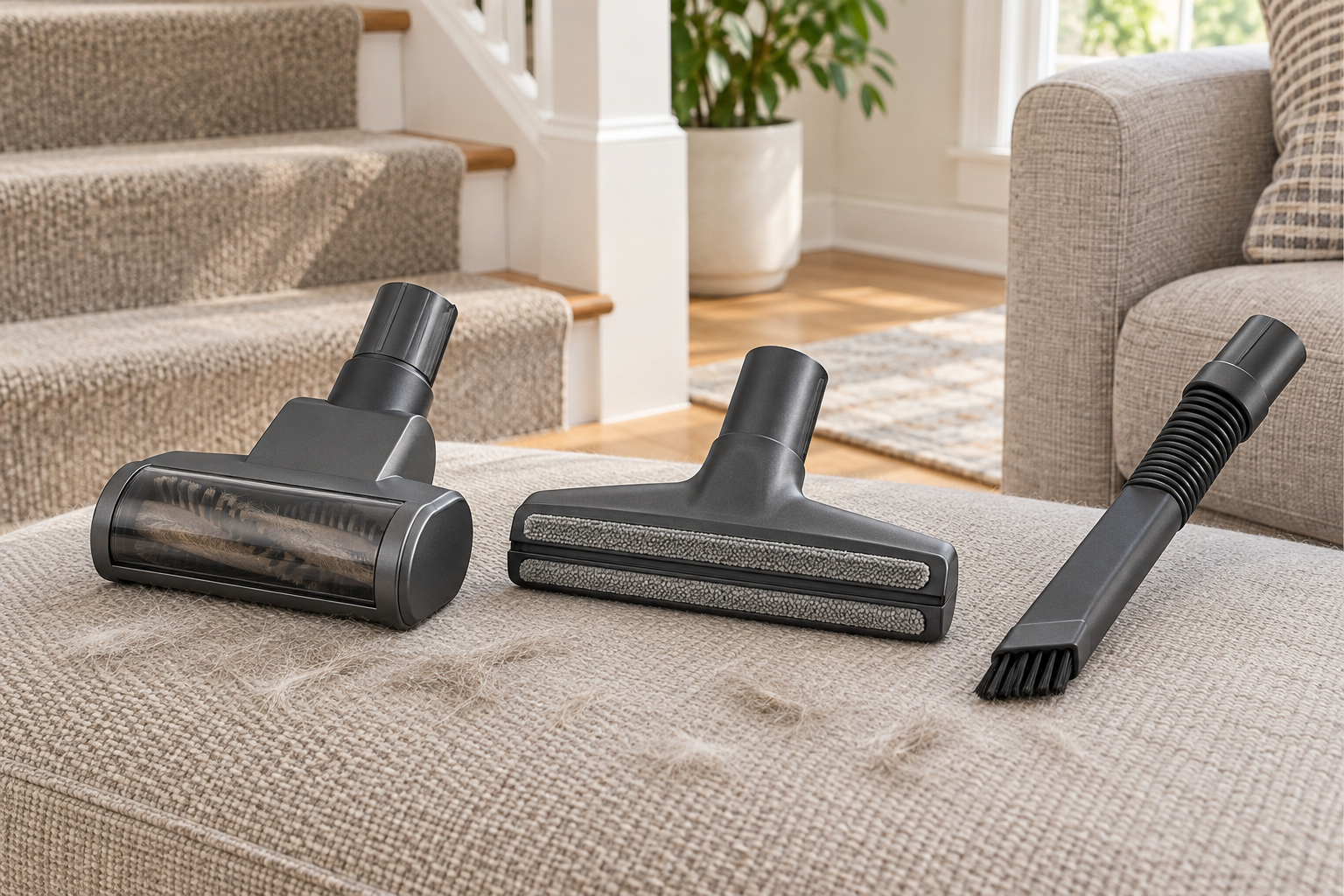
Quick Comparison
Motorized mini brush: active agitation
This format uses a small powered roller and may help lift hair held in compatible fabric or carpet. It also adds the most compatibility questions: power contacts, connector design, roller access, tangle removal, and surface restrictions. Do not assume an adapter can make an electrical tool work.
Wide upholstery tool: simple broad coverage
A non-powered wide head relies on suction plus fabric strips, rubber texture, or short bristles. It suits flatter sofa panels and generous stair treads, but a wide head can lose contact on curved arms, narrow steps, piping, or deep seams.
Brush-crevice tool: controlled edge access
A narrow nozzle with a brush end reaches seams, corners, riser edges, and tight gaps. Its small cleaning path makes a full sofa or staircase slow, so it works best as a companion tool rather than the only attachment.
Run a Compatibility Preflight
- Identify the exact vacuum: record the brand, full model number, hose or wand connection, and whether the accessory port supplies power.
- Start with maker documentation: check the manual and official accessory list. A stated diameter alone may not account for locking tabs, tapered fittings, seals, or electrical contacts.
- Measure the work area: note stair-tread depth, sofa seam width, furniture curves, hose reach, and where the vacuum body can rest without blocking the route.
- Check the surface: follow both the furniture or carpet care label and the tool instructions. Test an inconspicuous spot when the surface maker recommends it.
- Review the return terms: compatibility claims can be incomplete. Keep packaging until fit and documented use are confirmed without forcing the connection.
A universal label is not proof of universal fit. Do not tape, force, or loosely hold a mismatched connector, and do not use a powered head through an adapter unless both makers explicitly document that setup.
Selection Criteria That Matter
- Connector and lock: require an exact model list or documented diameter and locking geometry. Include any required adapter in the stored setup.
- Powered versus air-driven: a motorized head needs a compatible powered connection; a turbine head uses airflow and can behave differently as the vacuum filter or bin loads.
- Tool width: a broad head covers flat fabric faster, while a narrow head turns more easily on steps and around cushion edges.
- Brush design: rollers agitate; rubber textures and lint strips pull across fabric; soft bristles loosen hair near seams. Match the contact material to approved surfaces.
- Neck movement: a swivel or angled neck can help the head remain flat, but extra joints add places to inspect for hair and wear.
- Roller access: compare whether the cover opens as directed and whether wrapped hair can be removed without improvised disassembly.
- Hose reach and control: the attachment is only useful if the hose reaches every step while the vacuum stays stable and the route remains clear.
- Storage: confirm whether the tool fits onboard, on a wall dock, or in a labeled bin without bending a flexible neck or losing an adapter.
Clean and Store the Attachment
Unplug or power down the vacuum before handling a roller or clearing a blockage, following its manual. Remove wrapped hair only by the documented method, keep fingers and loose clothing away from moving parts, and do not wash a powered head unless its maker specifically permits it. Let washable, non-powered parts dry fully before reassembly.
Check the airway, brush strips, roller ends, locking tabs, seals, and adapter after use. Retire cracked connectors, exposed wiring, jammed rollers, or parts that no longer lock securely. Store the attachment dry and out of pet reach.
Who Should Skip a Separate Attachment?
Skip the purchase when your vacuum already includes an approved upholstery or mini tool that handles the real surfaces, or when a manual pet-hair remover for sofas and seats is quicker for small jobs. Skip a motorized head when the vacuum lacks a documented powered port, and skip any tool whose listing does not identify compatible models clearly enough to verify.
A separate handheld vacuum may fit better when carrying the main vacuum on stairs is awkward, the hose cannot reach safely, or tool changes make short sessions impractical. Keep pets away from cords and active equipment, pause if the sound causes distress, and follow the vacuum and surface makers' instructions.
Bottom Line
Choose a motorized mini brush only for a documented powered match, a wide upholstery tool for broad compatible fabric, or a brush-crevice tool for edges and seams. Exact connector fit, surface approval, controllable dimensions, and maintainable brush parts matter more than a generic pet-hair label.