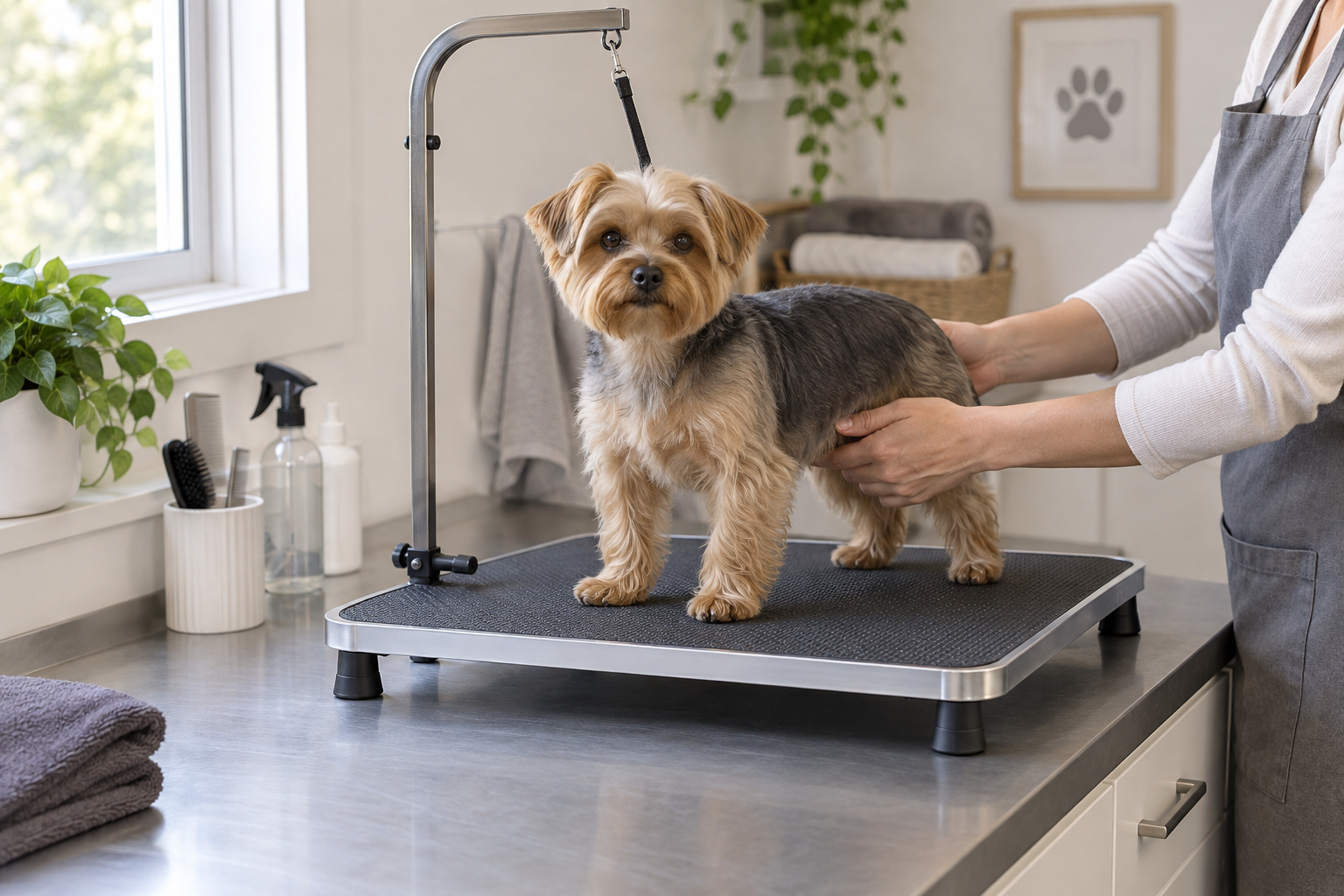
 Tabletop platform
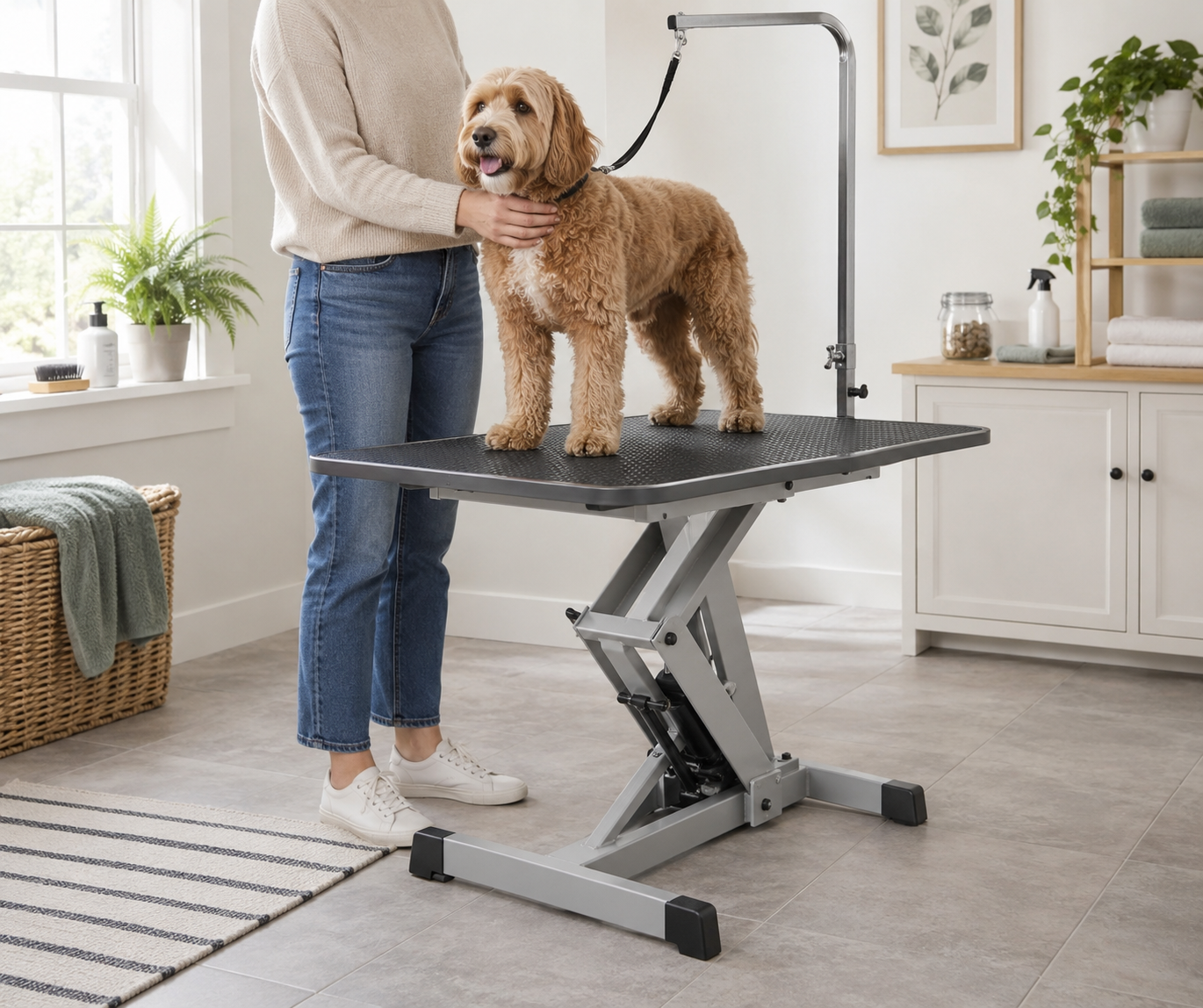 Adjustable-height table
Quick Answer
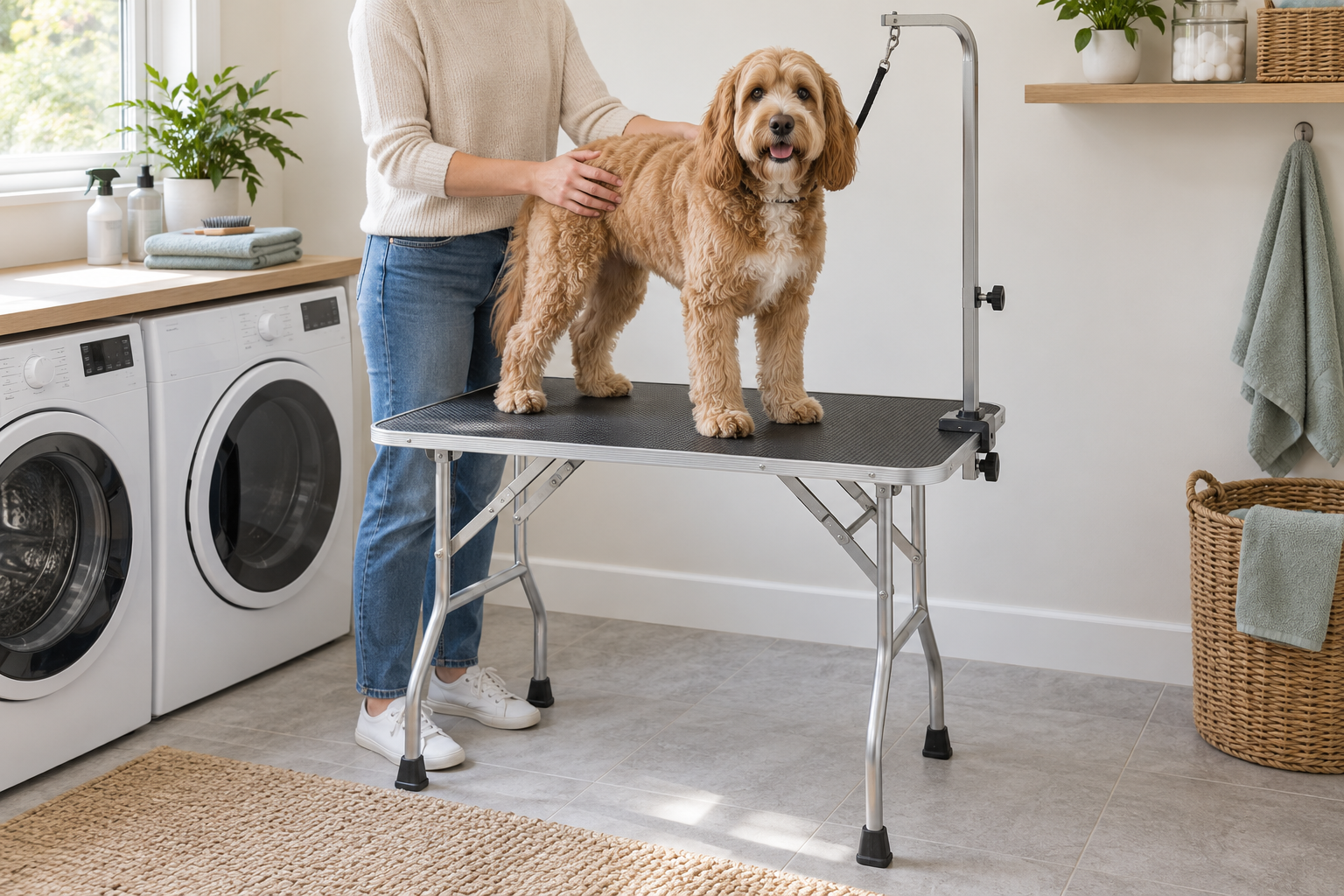
Choose a folding-leg table when you need a full-height surface that can be stored after use and you can safely handle its carrying weight and locking legs.
Choose a tabletop platform for an appropriately sized small dog only when you already have a broad, level, structurally suitable host surface and the platform is explicitly designed for that placement.
Choose an adjustable-height table when several documented working heights matter enough to justify a heavier base, a larger stored footprint, and any lift or electrical maintenance.
A grooming table does not make handling safe, calm a fearful dog, prevent a fall, or replace a qualified groomer or veterinarian. Never leave a dog unattended on any raised surface. Stop when the dog is distressed, painful, unstable, or trying to escape.
Measure the Complete Setup, Not Just the Top
Start with the dog standing naturally on the floor. Compare the dog's standing length and comfortable stance width with the table's usable top—not the outside frame alone. The dog needs room to stand and turn only as permitted by the maker's instructions without paws crowding an edge. Verify the exact stated load for the complete table, but do not treat a load number as proof of stability or fit.
Next, tape out the open footprint on the floor. Include splayed legs, pedals, lift bases, arm clamps, and enough clear space for the owner to stand without backing into a wall, appliance, door, cord, or stored item. Place the setup on a level surface specified by the maker, away from stairs and household traffic.
Finally, measure the storage path: doorways, closet opening, shelf depth, folded thickness, and the weight you would need to carry. A table that technically folds is not a small-home fit when it blocks a route, cannot stand or lie as directed, or is too awkward to move securely.
How the Three Formats Differ
Folding-leg tables
This format combines a full-height top with legs that fold beneath it. Compare open dimensions, usable top, fixed working height, table weight, folded thickness, leg-lock design, cross-bracing, feet, and whether the grooming arm must be removed for storage. Confirm every lock before the dog approaches the setup.
The tradeoff is handling. A larger top may suit more dogs but creates a heavier, wider object to carry. Skip a folding table if you cannot open, lock, move, and store it without pinched fingers, strained lifting, or leaning it where it can fall.
Tabletop platforms
A low-profile platform can reduce stored volume, but it shifts important requirements to the host surface. Follow the maker's placement directions and verify that the counter or table is broad, level, stable, undamaged, and able to support the combined load. All platform feet must remain fully supported—never bridge a sink, appliance, gap, or narrow counter.
This is generally a small-dog format. A platform is a poor fit when the dog crowds the edges, the base can slide, the host surface is not verified, or grooming supplies leave too little working room.
Adjustable-height tables
Manual, hydraulic-style, or powered lift tables let the top move through a stated range. Compare the minimum and maximum heights, full base dimensions at every position, control location, table weight, movement directions, maintenance, and—when powered—cord routing and electrical certification information.
Height choice does not remove lifting or transfer questions for the dog. Follow the exact maker instructions, keep paws and hands away from moving parts, and skip the format if the base or controls create congestion in the room.
Selection Criteria That Matter
- Usable top: Check the flat standing area after accounting for raised edges, clamps, or rounded corners.
- Complete footprint: Measure legs, base rails, pedals, cords, and owner standing space—not only the tabletop.
- Stated load and dog fit: Confirm both for the exact model; neither substitutes for stable placement and close supervision.
- Surface and edge: Look for documented slip-resistant construction, intact edge trim, and cleaning directions. Replace or retire damaged surfaces.
- Base and feet: Check locks, braces, contact points, leveling instructions, and compatibility with the actual floor or host surface.
- Working height: Compare a fixed or adjustable height with the owner and routine without assuming an ergonomic benefit.
- Arm and loop: Treat these only as maker-directed positioning accessories, never fall protection or permission to leave the dog unattended. Do not improvise restraint.
- Cleaning and drying: Prefer a top and frame you can wipe as directed and dry fully, including seams, clamps, and textured surfaces.
- Stored dimensions and weight: Verify the complete dry table, removable arm, hardware, and safe storage position.
- Return terms: Dog tolerance and room fit can be uncertain, so review current seller and manufacturer terms before assembly or use.
Use, Cleaning, and Storage Are Part of the Purchase
Read the complete assembly and use instructions before introducing the dog. Set up without the dog present, verify every fastener, lock, foot, surface, and arm connection, then keep one attentive adult within immediate reach whenever the dog is on the raised surface. Do not rely on a loop or arm to hold a dog that is pulling, panicking, sitting abruptly, or trying to jump.
Keep the session cooperative and limited to routine care the dog already accepts. A table is not the place to work through fear, severe matting, pain, wounds, skin changes, sudden sensitivity, aggression, or mobility difficulty. Contact a qualified groomer, veterinarian, or appropriate reward-based professional for those concerns.
After use, remove loose hair and clean only with methods approved for each material. Dry textured tops, edges, clamps, feet, joints, and removable parts before folding or covering the table. Inspect for looseness, corrosion, cracks, torn matting, exposed edges, unstable feet, or changes in lift behavior. Stop using a damaged or unpredictable setup.
Store the clean table so it cannot tip, unfold, roll, or block an exit. Keep detachable loops, hardware, cords, and grooming tools inaccessible to pets and children. For dry brushes and combs, use a separate grooming-caddy decision guide rather than piling supplies onto the table.
Who Should Skip a Grooming Table?
Skip every raised table when the dog is fearful, painful, unstable, likely to jump, too large for the usable top, or not suited to cooperative home grooming. A floor-level routine or qualified groomer may be the better choice; health or mobility changes belong with a veterinarian.
Skip a folding table when you cannot manage its weight, verify every leg lock, or store it securely. Skip a tabletop platform when the host surface or dog fit is uncertain. Skip an adjustable-height table when the base, controls, cord, or maintenance overwhelm the room and routine.
Skip buying one when a nonslip floor-level mat already supports the short brushing or towel-drying routine your dog accepts. A specialized table is convenience equipment, not a requirement for responsible coat care.
Related Grooming Guides
Compare brush formats for routine coat cleanup, decide whether grooming gloves fit willing contact, or organize dry supplies with the small-bathroom grooming organizer guide.
Bottom Line
The best small-home grooming table is the format that fits the dog, the complete open workspace, the owner's handling limits, and a secure storage location. Choose folding legs, a tabletop platform, or adjustable height as a practical tradeoff, verify every current specification and instruction, and skip the table when calm floor-level care or a qualified professional is the better fit.