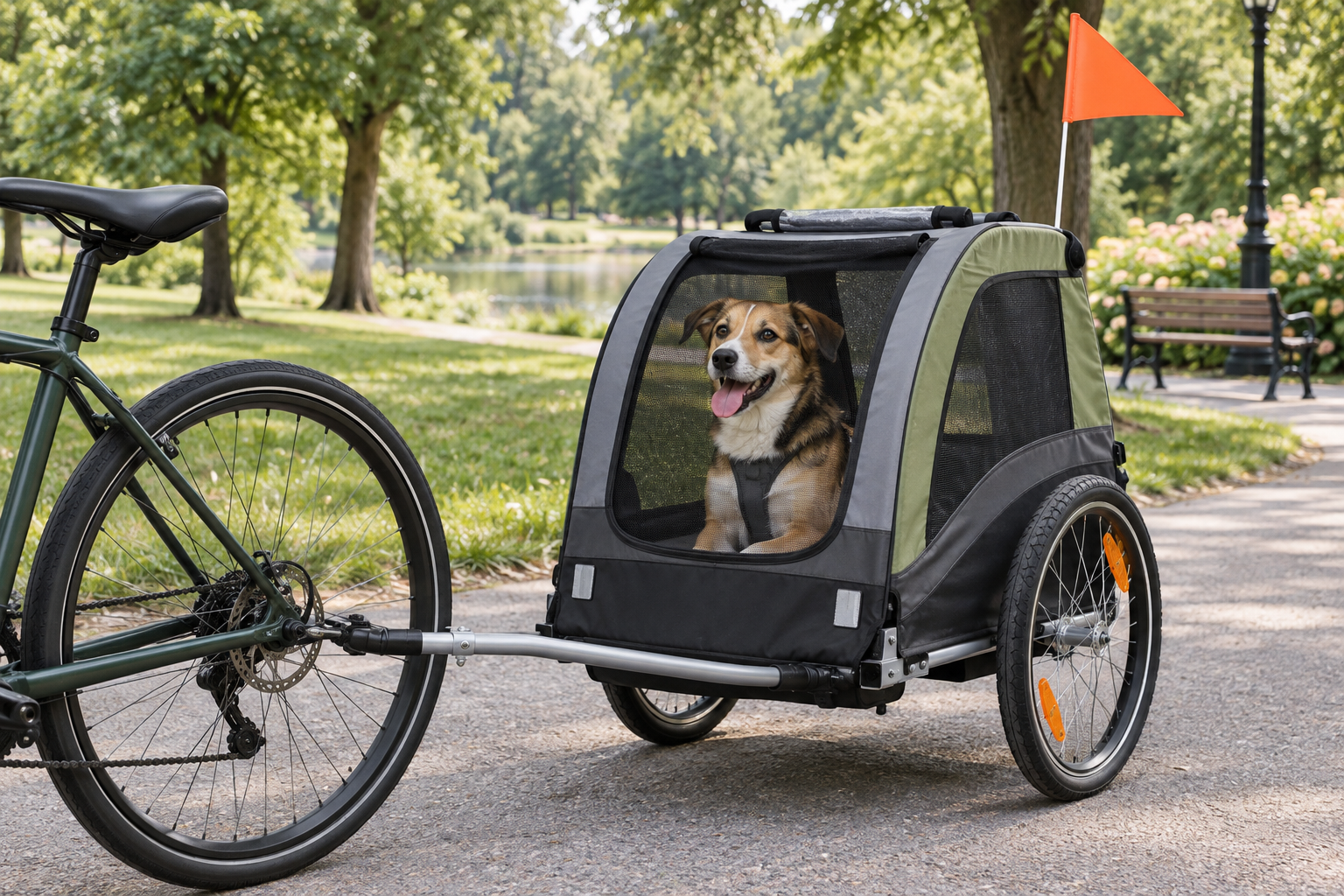
This is a category-level buying framework, not a road-safety guarantee, riding lesson, veterinary recommendation, or hands-on test. A trailer changes bicycle width, weight, acceleration, braking, turning, balance, and stopping distance. Follow the bicycle and trailer makers' instructions, check local rules, and get qualified bicycle-shop help when compatibility or setup is uncertain.
Quick Comparison
Compact two-wheel trailers: less bulk, tighter cabin limits
A compact two-wheel format may be easier to store and move by hand, but the dog still needs adequate usable floor length, width, seated height, and entry clearance. Exterior labels such as “small” or “medium” do not establish fit. Also measure the full wheel track; a narrow-looking cabin can still have a wide axle.
Folding-frame trailers: storage convenience with more setup checks
A folding frame can reduce stored height or length. The tradeoff is a repeatable setup routine: inspect hinges, pins, locks, wheel attachment, fabric tension, and the maker's riding configuration every time. Never assume a partly opened frame or improvised fastener is usable.
Roomier low-entry cabins: easier access can mean more width and weight
A broad, lower doorway may simplify entry for a dog that already accepts the trailer calmly. A larger cabin can also be wider, heavier, harder to store, and more noticeable during turns or stops. Do not choose extra cabin size without checking the bicycle, route, rider, doorway, vehicle, and storage fit.
Measure the Dog, Cabin, and Entry
Observe the dog's natural seated and lying positions, then compare those measurements with the trailer's stated usable interior rather than its exterior shell. Confirm floor length and width, seated headroom beneath the closed canopy, entry width and height, threshold height, and the maker's stated load and dog-size guidance.
The dog should not be forced, lifted against veterinary advice, or tethered by the neck. Use only the maker-approved interior attachment method and a correctly fitted harness if the instructions require one. Keep every closure fully secured as directed. If pain, illness, injury, breathing concerns, heat sensitivity, or mobility changes affect the decision, ask a veterinarian whether this kind of outing is appropriate before buying.
Verify the Bicycle, Hitch, and Route Together
“Universal” language is not enough. Identify the exact bicycle, rear axle type and diameter, dropout or frame design, brake and drivetrain clearances, wheel size, and any e-bike restrictions. Compare those details with the current trailer hitch instructions. Do not improvise adapters, clamp to an unapproved point, or assume a trailer approved for one bicycle fits another.
Ask a qualified bicycle shop or the trailer maker when any part is unclear—especially with thru-axles, hub gears, unusual dropouts, carbon frames, e-bikes, or existing racks and accessories. Check both bicycle and trailer limits; the lower applicable limit governs. A flag or reflector may improve visibility, but neither prevents a collision or makes a route safe.
Plan a calm paved route allowed by local rules, away from traffic and steep grades. Account for the complete trailer width, surface condition, curbs, bollards, gates, driveways, turns, stopping areas, heat, weather, and a turnaround option. Walk the route first if necessary. The page does not recommend road riding.
Selection Criteria That Matter
- Usable cabin: Verify interior floor length and width, closed-canopy height, openings, threshold, and floor support.
- Stated limits: Follow the current dog-size, total-load, speed, bicycle, surface, weather, and use restrictions from both makers.
- Hitch system: Confirm axle compatibility, coupler parts, backup retention, installation torque, clearances, and replacement-part availability.
- Frame and wheels: Inspect attachment, tire condition and pressure, guards, bearings, pins, locks, and frame joints before each use.
- Ventilation and closure: Check mesh area, weather panels, door closures, seams, and the dog's position without claiming temperature control.
- Entry and floor: Prefer an opening and supported floor the individual dog can use without forcing; follow veterinary guidance when lifting or mobility is a concern.
- Handling: Account for added width and weight, then follow maker guidance for practice without the dog before any occupied use.
- Cleaning: Check removable floor or liner instructions, fabric care, drying access, and whether dirt can be cleared from seams and hardware.
- Storage: Measure the assembled and folded trailer, wheel-removal steps, carrying weight, and a dry storage location away from pet access.
- Returns and support: Read current return terms before outdoor use and confirm manuals, spare hitches, wheels, fabric, and other wear parts are available.
Set Up Conservatively
Assemble the trailer exactly as directed, keep the manual, and have uncertain work checked by a qualified bicycle professional. Inspect the hitch, backup retention, tires, wheels, frame, pins, floor, fabric, closures, harness attachment, reflectors, and flag before every outing. Replace damaged or missing parts only with approved equivalents.
Let the dog investigate a stationary, secured trailer without force. Do not begin a ride merely because the dog entered once. Stop if the dog shows distress, repeatedly tries to escape, chews the cabin, cannot settle, or changes position in a way that interferes with secure use. A qualified trainer can help with fear or handling concerns; products do not treat behavior.
Who Should Skip a Dog Bike Trailer?
Skip this purchase if the bicycle or axle is not explicitly compatible, the dog does not fit the usable cabin, the rider cannot comfortably manage the added system, the planned route involves traffic or surfaces outside maker guidance, or storage and inspection will be inconsistent. Also skip it when local rules prohibit the setup.
Do not use a trailer as a workaround for pain, exercise intolerance, anxiety, reactivity, injury, illness, or heat risk. Ask a veterinarian about health or mobility concerns and a qualified behavior professional about serious fear or escape behavior. A walk, stationary outdoor time, carrier used exactly as directed, pet stroller, or staying home may be the better plan.
The Bottom Line
Start with compatibility, not cabin color or accessory count. A viable trailer must pass five separate checks: dog fit, bicycle and hitch fit, rider handling, paved-route fit, and consistent inspection and storage. When any one remains uncertain, pause the purchase and get maker, bicycle-shop, veterinary, or qualified behavior guidance as appropriate.