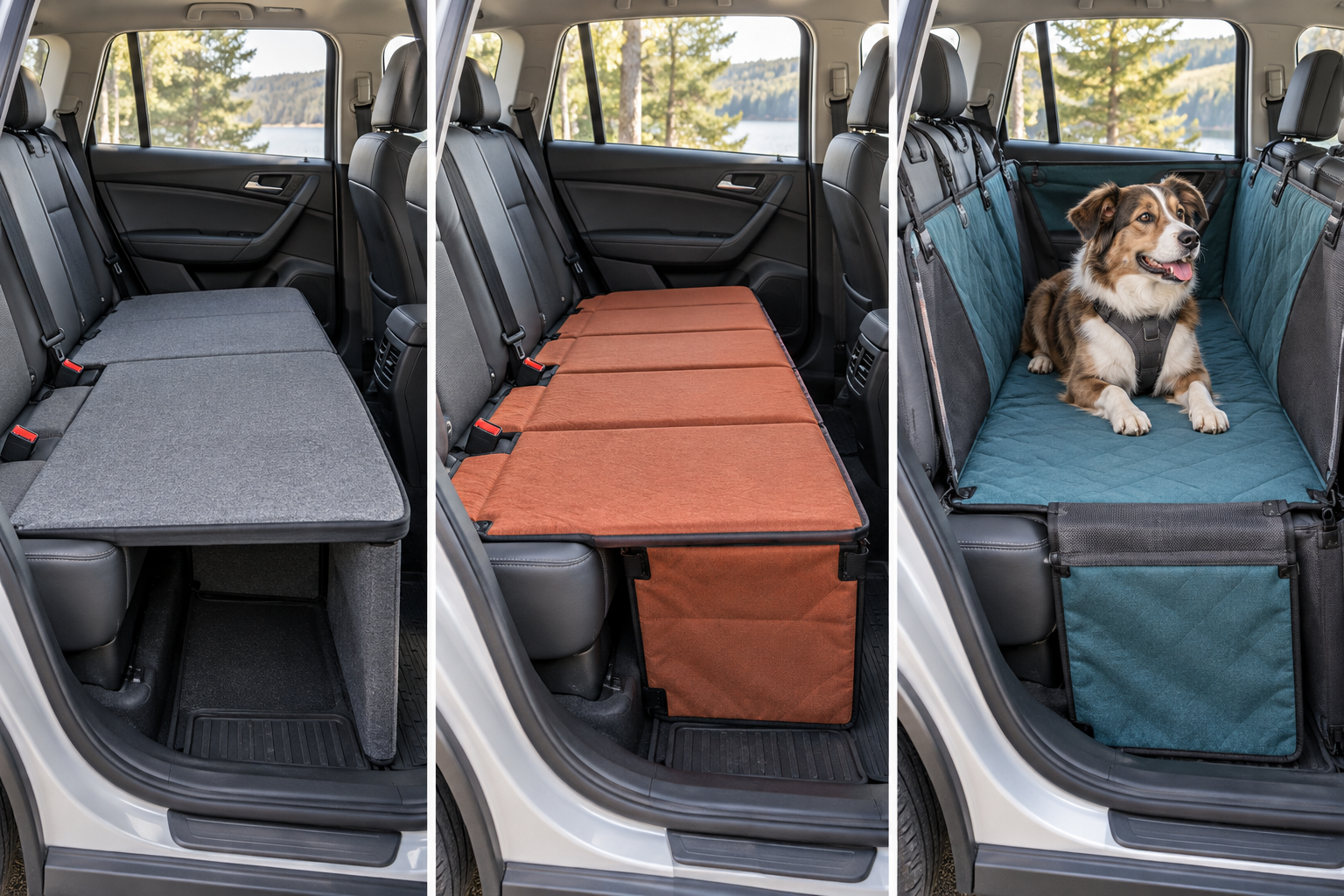
Quick Answer
Choose a rigid platform when the measured space accepts a single supported panel and bulky storage is manageable. Choose a folding platform when passenger changeovers or home storage make compact folding useful, provided every section stays supported and lies flat. Choose a hammock-integrated extender when you also need compatible seat and door-side fabric coverage and can clean, dry, install, and store the larger assembly.
Do not choose by a universal-fit label or by the dog’s weight alone. Verify the product maker’s vehicle-fit and stated-load guidance, then follow the vehicle maker’s instructions. An extender does not replace an appropriate restraint, carrier, crate, barrier, or professional vehicle-installation advice.
Measure the Vehicle Before Shopping
Park on a level surface and measure the rear bench width, cushion depth, footwell opening, footwell depth, and height from the footwell to the seat surface. Note the center tunnel, rear console, vents, seat tracks, buckle stalks, child-seat anchors, split-folding seams, door armrests, and the front-seat positions used by the driver and passenger.
Compare those numbers with the product’s deployed dimensions and required support points. The panel should not float beyond its described supports, bow over an obstacle, press against a console, interfere with front-seat adjustment, or leave an uncovered gap a paw could enter. “Fits most cars” is not a measurement.
How the Three Formats Differ
Rigid platform
A one-piece or minimally jointed panel can provide a straightforward surface with fewer hinge lines. Its tradeoffs are storage bulk, passenger changeover, and the need for exact vehicle geometry. Inspect panel edges, cover attachment, underside contact, and every stated support location.
Folding platform
Segmented panels can fold into a trunk or closet and may make partial removal easier. Compare the deployed seam and hinge layout, because a convenient fold can also create a gap, ridge, or unsupported section in the wrong vehicle. Confirm whether sections may be used independently.
Hammock-integrated platform
This format combines a support panel with fabric rising toward the front headrests and sometimes the doors. It can consolidate upholstery coverage, but adds straps, openings, side panels, laundry bulk, and more compatibility checks. Fabric walls are not structural restraints.
Buying Criteria That Matter
- Usable dimensions: compare the actual flat area with the bench and footwell—not only package width.
- Support construction: identify what supports each panel and whether the maker requires footwell legs, seat contact, straps, or another structure.
- Stated load guidance: stay within current maker instructions without treating the number as a safety or crash claim.
- Buckle and restraint access: preserve the exact connection points required by the separate travel setup; do not route hardware through an improvised opening.
- Vehicle functions: keep airbags, child-seat hardware, controls, vents, doors, windows, seat tracks, sensors, latches, and emergency equipment unobstructed.
- Surface and edges: reject sharp, exposed, curling, slippery, or easily displaced surfaces.
- Door coverage: check that optional side panels do not block handles, locks, switches, speakers, seals, or window movement.
- Cleaning: confirm which cover pieces detach and whether panels, foam, inserts, and straps can be cleaned and fully dried as directed.
- Storage: measure the folded product and choose a secure storage location so it cannot become loose cargo.
- Return terms: test fit in a parked empty vehicle, following seller terms, before relying on it for a trip.
A Practical Setup, Inspection, and Care Routine
Read both vehicle and product instructions. Install the empty extender in the parked vehicle, move the front seats through their normal range, open both rear doors, test permitted seat-folding positions, and confirm all needed buckles and controls remain reachable. Press each section by hand only as the maker directs and look for shifting, tilting, bowing, gaps, or contact with sharp trim.
Arrange the dog’s appropriate travel and restraint setup separately. Do not clip a restraint to the extender, fabric loops, headrest straps, or an opening unless the relevant makers explicitly direct that connection. Never use the extender to let a dog move freely around the cabin.
After a trip, remove grit before wiping or washing. Follow the material-specific care label, dry every fabric layer and panel fully, and inspect seams, straps, fasteners, covers, joints, supports, and edges. Stop using a product that cracks, bends, delaminates, develops a gap or sharp edge, or no longer stays in its intended position.
Who Should Skip a Back-Seat Extender?
Skip it when fit or support is uncertain. An ordinary fitted seat cover may address upholstery mess without spanning the footwell.
Skip it when rear passengers, child seats, or frequent seat folding need the same space. Repeated rushed reconfiguration can make a simpler setup more realistic.
Skip it as a remedy for travel distress or unsafe movement. If a dog pants heavily when conditions are mild, vomits repeatedly, panics, tries to escape, becomes suddenly reluctant to ride, or has pain or mobility concerns, contact a veterinarian; a qualified trainer or behavior professional can help with non-medical travel routines.
Skip it when a carrier, crate, or other established travel setup already fits appropriately. More platform area is not automatically an improvement.
Related Car-Travel Guides
Compare a dog car hammock with a cargo liner when the riding zone is still undecided. For upholstery protection only, use the dog car-seat cover guide. Organize towels and cleanup supplies with the car-ride cleanup kit.
Bottom Line
The best dog back-seat extender is the format that fits the measured vehicle, keeps the whole platform supported and level, preserves every required function and connection, and can be installed, cleaned, inspected, and stored consistently. Choose rigid, folding, or hammock-integrated construction for those practical differences—not for an unsupported safety promise.