Quick Answer
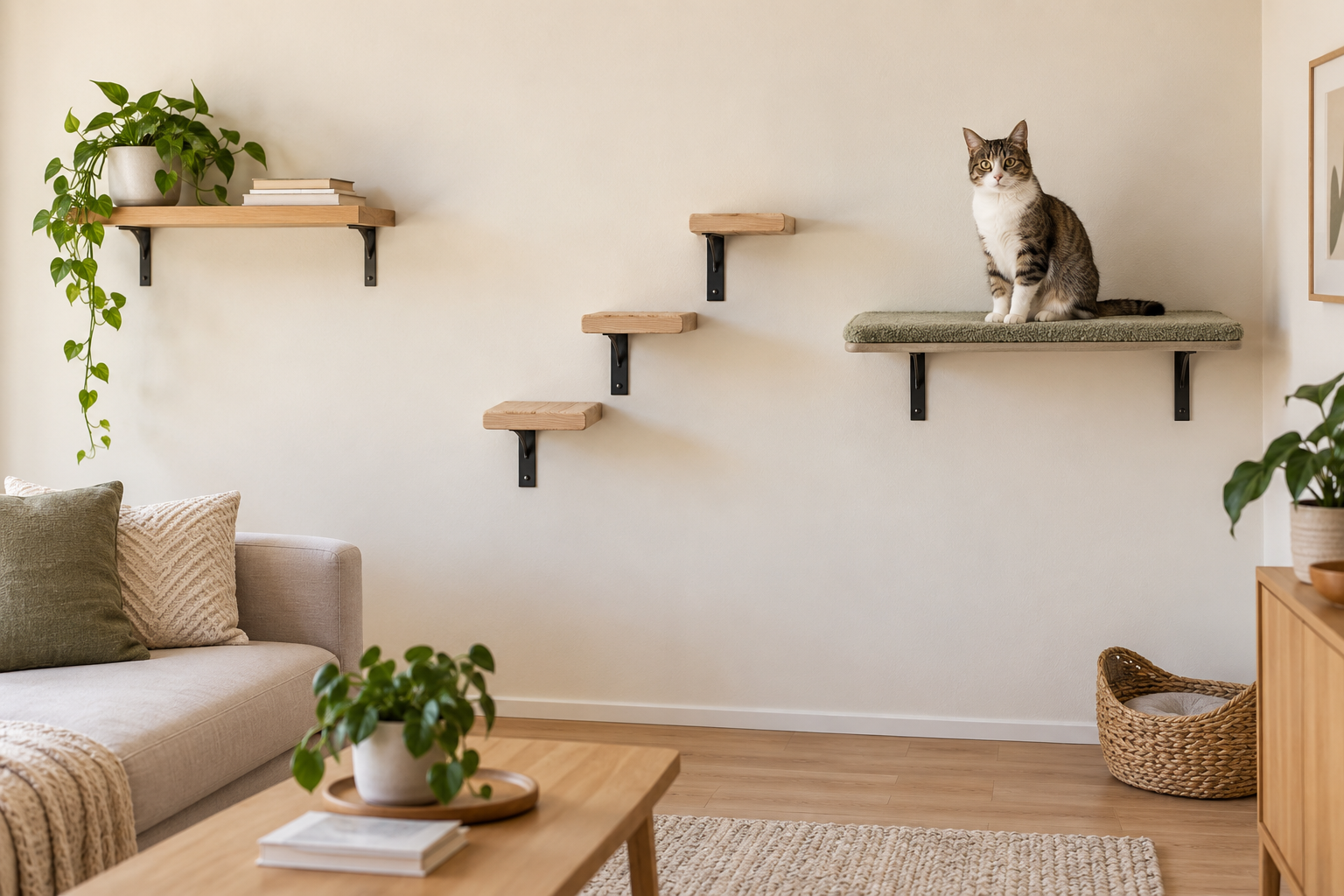
Choose a single shelf when you need one resting surface and the cat already has a comfortable way on and off. Choose step shelves when the route itself is the problem and the wall has verified mounting positions for every piece. Choose a wider carpeted platform when resting area and surface texture matter more than a minimal profile.
Choose none until you know the wall construction and can follow the manufacturer's hardware and mounting directions. A cat shelf is not a fall-prevention product, and a listed load does not make an improvised installation appropriate. If the wall type, hidden services, or required fastener is uncertain, use a qualified installer.
Measure the Wall, Platform, and Route
- Usable surface: record the flat standing or resting area, not the decorative outline.
- Wall compatibility: identify the wall construction and compare it with the maker's directions. Included hardware does not fit every wall.
- Mounting points: map every bracket or fastener and check for trim, switches, outlets, pipes, wiring, and other hidden-service concerns before drilling.
- Approach and exit: plan a complete route. Keep doors, windows, cords, hot surfaces, and fragile objects out of the path.
- Spacing: base gaps on exact platform edges and the cat's normal movement. Do not force a cat to use a jump route.
- Room clearance: keep the installation out of narrow human walkways and away from awkward landing zones.
How the Formats Differ
Single shelves
A single platform is the lowest-complexity purchase, but it still needs an appropriate access route. Compare depth, width, bracket projection, edge shape, stated load, compatible walls, and surface grip. Skip it when nearby furniture would become an unstable step.
Step shelf sets
A set can create a compact vertical route, but it multiplies the measuring and mounting work. Check each piece rather than relying on overall dimensions. Confirm whether pieces can be spaced independently, whether hardware differs, and whether replacements are available.
Carpeted platforms
A wider covered shelf can provide more resting area and traction. The tradeoff is upkeep: inspect fabric edges, attachment points, seams, and exposed substrate. Prefer a removable or replaceable covering only when the listing and directions clearly support it; do not assume a glued surface is washable.
Installation, Introduction, and Inspection
Follow the product directions and wall-hardware requirements exactly. Do not substitute fasteners, skip mounting points, combine incompatible kits, or infer support from appearance. Keep the instructions and stated load information. When mounting conditions are unclear, pause and hire a qualified installer.
Before access, check every shelf by hand as the maker directs. Let the cat choose whether to explore it; do not place or lure a reluctant cat onto a high platform. Observe first uses and keep a floor-level resting place available.
Inspect brackets, fasteners, joints, coverings, edges, and the surrounding wall on the maker's schedule and after impact, movement, or cleaning. Stop use if a shelf shifts, a fastener loosens, the wall changes, fabric tears, material cracks, or an edge becomes rough.
Who Should Skip Cat Wall Shelves?
Skip them in an uncertain wall. If you cannot identify a compatible mount or get installation permission, choose a floor-standing alternative.
Skip them when the route cannot be made cleanly. Doors, cords, hot radiators, open windows, narrow ledges, breakables, and busy walkways are poor route components.
Skip them when normal movement has changed. New hesitation, missed jumps, falls, limping, pain, weakness, or other mobility changes call for a veterinarian, not a new elevated route.
Skip a full set when one surface solves the problem. More platforms mean more holes, hardware, inspection, and cleaning.
Related Small-Space Cat Guides
Compare cat trees and window perches. If drilling is unsuitable, see compact cat trees or cat window perches for renters. For floor-level options, compare small-apartment scratching posts.
Bottom Line
The best cat wall-shelf format is the one whose usable surface, complete route, wall requirements, hardware, cleaning, and inspection fit the real room. Start with installation feasibility, choose only as many platforms as the route needs, and treat every stated limit as one requirement—not permission to improvise the mount.