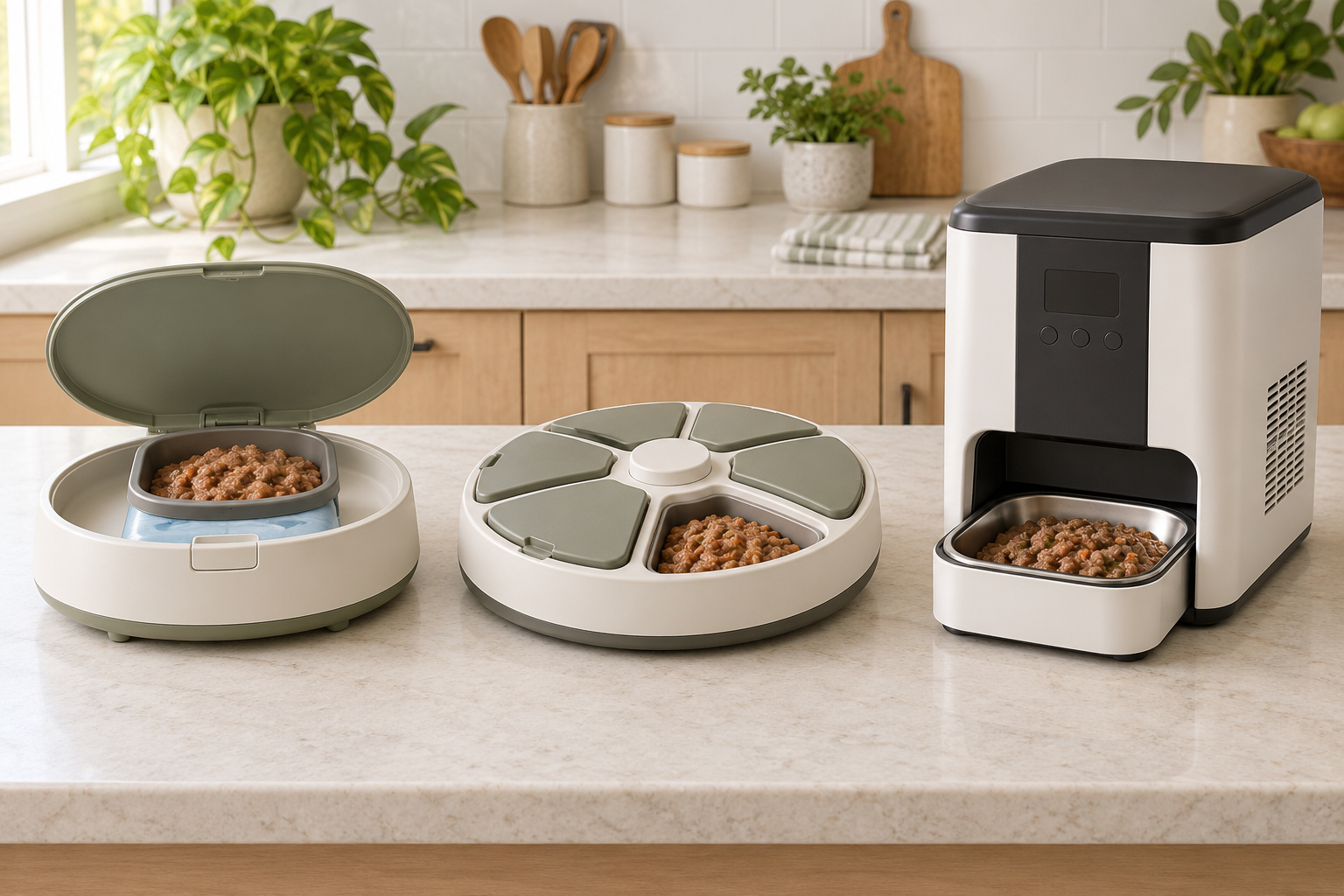
Quick Comparison
Choose a cooling-pack feeder only when its maker explicitly approves the food and defines a preparation and operating routine you can follow. Choose a rotating tray when individually filled compartments and their opening order are easy to verify. Consider powered refrigeration when documented temperature control and failure behavior justify the extra size, power dependence, noise, and cleaning.
Do not transfer storage times or temperature assumptions from one feeder, food, room, or online article to another. Follow the current food label and feeder manual. Ask your veterinarian to set meal amounts and timing, especially for a prescription diet, medical condition, young or senior pet, appetite change, or other individual concern.
Selection Criteria That Matter
- Explicit wet-food compatibility: the exact model should identify the food formats it accepts and how they must be loaded.
- Cooling method: distinguish a removable frozen pack, an insulated or covered tray, and active refrigeration. A covered tray alone is not refrigeration.
- Usable compartment size: compare measured capacity and shape with the veterinarian-guided meal, without overfilling edges or lid paths.
- Timer behavior: verify minimum and maximum intervals, opening order, clock retention, repeat settings, and what happens after a missed cycle.
- Food-contact parts: favor trays, bowls, seals, and lids that detach as directed and have reachable corners.
- Pet access: inspect lid fit and stability, but do not assume a feeder is tamper-proof.
- Power and failure response: learn what stops, what settings persist, and how the unit signals a problem.
How the Formats Differ
Cooling-pack covered feeders
This compact format pairs a timed lid with a removable cooling pack or tray. Compare how the pack is prepared, where it sits, whether condensation can reach the base, and the maker’s stated room and use conditions. Skip vague listings that do not provide food-handling instructions for the exact model.
Rotating covered trays
A motor turns a multi-compartment tray so one section becomes accessible. Check whether every compartment receives the same cooling method, how the first exposed meal is handled, and whether the sequence can be reviewed before starting. Compartment count does not establish how long food may remain in the unit.
Powered refrigerated feeders
Active cooling can offer more explicit control, but it adds a compressor or electronic cooling system, vents, cords, operating noise, and failure planning. Verify documented operating conditions, warm-up or pre-cooling instructions, display meaning, alarm behavior, and whether food-contact parts detach without exposing electronics.
Cleaning, Placement, and Power Planning
Wet-food residue reaches lid edges, seals, tray pivots, corners, and the area beneath removable dishes. Follow the maker’s disassembly and washing directions after each use, dry parts fully, and never immerse a powered base unless its manual explicitly permits it. Retire cracked, warped, deeply scratched, or damaged food-contact parts according to maker guidance.
Use a stable, washable location away from direct sun, heaters, moisture, and pet traffic that can tip or unplug the unit. Keep vents clear and route cords out of chewing and snag paths. Test the complete timer and opening sequence while present, then check that the food remained handled as directed and the pet could reach it comfortably.
Have a human fallback for power loss, cooling failure, a jammed lid, or a pet that does not eat. A notification, closed lid, cold pack, or display is not proof that the meal stayed within instructions or that the pet ate.
Who Should Skip an Automatic Wet-Food Feeder?
Skip one when the food label or feeder manual does not clearly support the planned use, room conditions are outside the stated range, nobody can check the mechanism and pet, or the pet opens, tips, chews, avoids, or guards the unit. A familiar bowl and responsible person may be simpler and more dependable.
Skip timed feeding when close appetite monitoring, medication, treatment, or direct meal supervision is required. Contact a veterinarian about refusal to eat, repeated vomiting, pain, weakness, marked thirst changes, or another concerning change; a feeder is a scheduling appliance, not a medical or nutrition solution.
Related Feeding Guides
If you use dry food, compare automatic feeders for scheduled dry meals. For shared homes where access—not timing—is the problem, see microchip feeder formats. The new-pet setup guide helps keep the wider routine practical.
Bottom Line
The useful wet-food feeder is the one whose documented food compatibility, cooling method, compartment size, timer, cleaning steps, power plan, and failure response all fit the established routine. Treat category searches as a shortlist, verify the exact current manual, and keep veterinary guidance and in-person checks in the plan.